
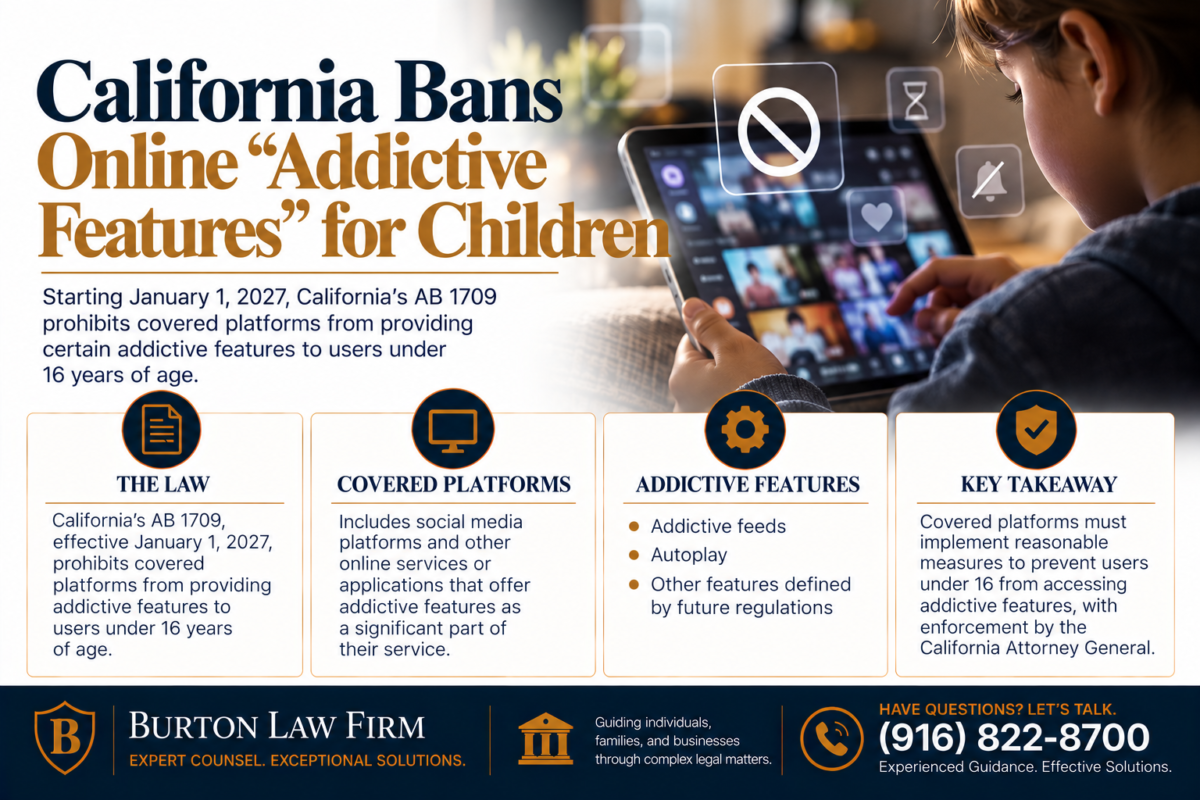
California enacted AB 1709, effective January 1, 2027, providing that “[a] covered platform shall not provide an addictive feature to a user who is under 16 years of age.”[1] A “covered platform” is defined as “an internet website, online service, online application, or mobile application, including, but not limited to, a social media platform, as defined in Section 22675, that offers users or provides users with an addictive feature as a significant part of the service provided by that internet website, online service, online application, or mobile application.” However, the term excludes “[a]n internet website, online service, online application, or mobile application that operates a feed for the primary purpose of cloud storage” or “for which interactions between users are limited to commercial transactions or to consumer reviews of products, sellers, services, events, or places, or any combination thereof.”[2]
The term “addictive feature” is defined as “any of the following psychologically exploitative features intended to maximize engagement that foreseeably lead to compulsive use:”[3]
- “An addictive feed.”[4]
- The term is defined as “an internet website, online service, online application, or mobile application, or a portion thereof, in which multiple pieces of media generated or shared by users are, either concurrently or sequentially, recommended, selected, or prioritized for display to a user based, in whole or in part, on information provided by the user, or otherwise associated with the user or the user’s device,” with several exceptions.[5]
- The definition does not apply if “any of the following conditions are met, alone or in combination with one another:”[6]
- “The information is not persistently associated with the user or user’s device and does not concern the user’s previous interactions with media generated or shared by others.”[7]
- “The information consists of search terms that are not persistently associated with the user or user’s device.”[8]
- “The information consists of user-selected privacy or accessibility settings, technical information concerning the user’s device, or device communications or signals concerning whether the user is a minor.”[9]
- “The user expressly and unambiguously requested the specific media or media by the author, creator, or poster of the media, or the blocking, prioritization, or deprioritization of that media, provided that the media is not recommended, selected, or prioritized for display based, in whole or in part, on other information associated with the user or the user’s device, except as otherwise permitted by this chapter and, in the case of audio or video content, is not automatically played.”[10]
- “The media consists of direct, private communications between users.”[11]
- “The media recommended, selected, or prioritized for display is exclusively the next media in a preexisting sequence from the same author, creator, poster, or source and, if the media is audio or video content, is not automatically played.”[12]
- “The recommendation, selection, or prioritization of the media is necessary to comply with this chapter or any regulations adopted pursuant to this chapter.”[13]
- “Autoplay.”[14]
- This is an undefined term.
- “Any other feature defined in regulations adopted pursuant to Section 22685 as an addictive feature.”
In addition to forbidding the provision of addictive features to users under 16 years of age, a covered platform shall also “implement reasonable measures to ensure that users under 16 years of age are not provided any addictive feature on the covered platform.”[15] A separate section empowers the Attorney General to “adopt regulations to implement and enforce this chapter in order to further the purpose of protecting minors online.”[16] Specifically, “the Attorney General may alter the scope of ‘covered platform’ if the Attorney General determines that doing so is necessary to ensure that ‘covered platform’ applies to internet websites, online services, online applications, or mobile applications that make addictive features available to users under 16 years of age.”[17] Therefore, the Attorney General may adopt regulations that rescind an exception to the covered platform definition or otherwise alter the meaning’s scope. The bill created “The e-Safety Advisory Commission” to provide nonbinding recommendations to the Attorney General on the safety of minors online.
This law may be enforced “only by the Attorney General, or a local public prosecutor” through a civil penalty of up to $50,000 “per affected minor for a knowing violation,” and up to $25,000 “per affected minor for a negligent violation.”[18] However, “a court shall consider the size of the covered platform, the severity and duration of the violation, and the covered platform’s good faith efforts to comply.”[19]
It may be evident that this law targets the largest social media platforms. Yet, there is not a minimum threshold for the popularity or size of the website or application to be considered a “covered platform.” With exceptions, a covered platform is instead a website or an application that “provides users with an addictive feature as a significant part of the service.”[20] The term “significant” is undefined here. This law centers on “addictive features.” These are three categories of “psychologically exploitative features intended to maximize engagement that foreseeably lead to compulsive use.”[21] It is unclear whether these are distinct requirements or if the listed features are automatically deemed to meet that description. For example, it is uncertain whether the Attorney General must prove that an instance of “[a]utoplay” is a “[1] psychologically exploitative feature[] [2] intended to maximize engagement that [3] foreseeably lead to compulsive use” or if all three elements are imputed to the feature simply because it is “[a]utoplay.” There are substantial ambiguities, but the Attorney General will have ample authority to clarify them.
[1] BPC § 22683(a)(1); Cal Const, Art. IV § 8(c).
[2] BPC § 22683(c)(2);
[3] BPC § 22682(a).
[4] BPC § 22682(a)(1).
[5] BPC § 22682(b).
[6] Id.
[7] BPC § 22682(b)(1).
[8] BPC § 22682(b)(2).
[9] BPC § 22682(b)(3).
[10] BPC § 22682(b)(4).
[11] BPC § 22682(b)(5).
[12] BPC § 22682(b)(6).
[13] BPC § 22682(b)(7).
[14] BPC § 22682(a)(2).
[15] BPC § 22683(b).
[16] BPC § 22685(a).
[17] BPC § 22685(b).
[18] BPC § 22686.
[19] BPC § 22686(c).
[20] BPC § 22682(c)(1).
[21] BPC § 22682(a).