
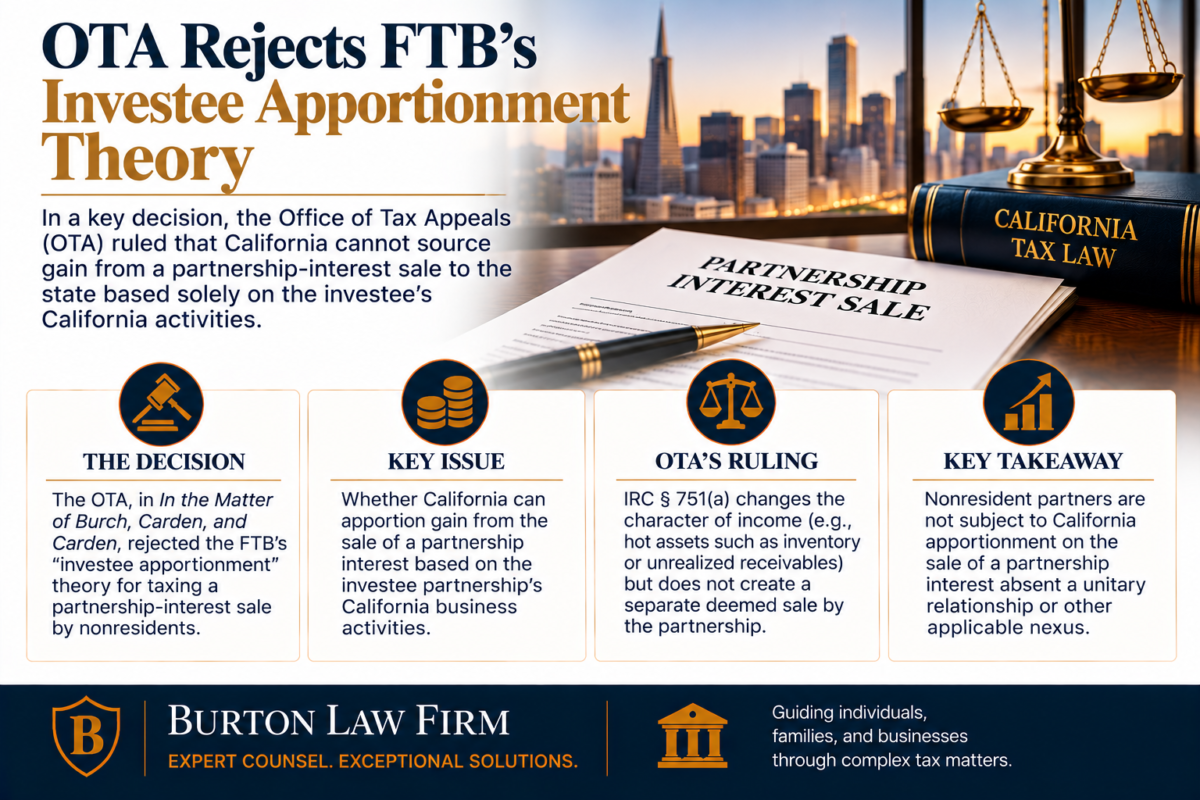
In the Matter of Burch, Carden, and Carden, the Office of Tax Appeals (OTA) ruled on the sale of partnership interests by nonresidents.[1] The individual taxpayers owned interests in JCB Investments, LLC, which in turn owned about 28% of Tory Burch LLC, both partnerships. “Tory Burch conducted a unitary trade or business within and without California.”[2] JCB sold part of its interest in Tory Burch and the taxpayers characterized the sale “as nontaxable, non-California source income under R&TC section 17952.”[3] However, the Franchise Tax Board claimed that “two distinct transactions occurred.”[4] The FTB accepted the taxpayers’ treatment for some of the proceeds because they “are nondomiciliaries of this state and the partnership interests did not acquire a business situs here.”[5] However, the remainder of the proceeds amounted to “apportionable business income resulting from Tory Burch’s deemed sale of its IRC 751(a) property, which is sourced to California under Regulation section 17951-4(d),” according to the FTB.[6] The FTB claimed that JCB sold the “hot assets” of “unrealized receivables and inventory items” in selling the Tory Burch interest.[7] “FTB’s position is based in large part on its Legal Ruling 2022-02, issued on July 14, 2022.”[8] Indeed, Legal Ruling 2022-02 was apparently issued in response to this case.
The OTA explained that the sale of partnership interests is generally taxed as capital gain under § 741. Yet § 741 has an exception cross-referencing § 751 whereby, as the D.C. Circuit in Rawat v. Commissioner stated, “gain from the sale of a partnership interest attributable to ‘inventory items’ or ‘unrealized receivables’ is taxable as ordinary income rather than as a capital gain.”[9] The taxpayers argued that the federal treatment does not affect the state sourcing rules under RTC § 17952. The OTA found Rawat persuasive because it addressed the same question at the international level. That is, the IRS argued that the hot asset sale portion was U.S.-source income. “[T]he court concluded that IRC section 751[(a)] was only meant to change the character of income and not to contrive a separate transaction, contrary to what the IRS advanced (and FTB advances here).”[10] In contrast, § 751(b), governing the treatment of hot assets distributed to partners, did create a distinct transaction. In § 751(a), the language was “shall be considered as an amount realized from the sale or exchange of property other than a capital asset.” Section 751(b)’s language “be considered as a sale or exchange of such property” served as § 751(a)’s foil. Similarly, § 338(a) provides that “if the purchasing corporation makes an election, the target corporation ‘shall be treated as having sold all of its assets,’ even though there was actual sale of stock by its shareholders.” That is enough to create a deemed transaction. Although the OTA did not analyze it, § 336(e)’s language “to treat such sale, exchange, or distribution as a disposition of all of the assets,” would likely have the same effect in the OTA’s opinion.
In Appeal of Bense (79-SBE-055), the Board of Equalization (BOE) “observ[ed] that partnership-interest sales attributable to IRC 751(a) property should be fragmented and treated as two sales.”[11] Yet this “does not mean the partnership itself is deemed to have sold such property or that the taxpayers received a distributive share of ordinary income from the partnership reflecting the partnership’s deemed sale of such property.”[12] Instead, the BOE was speaking figuratively rather than literally. “Moreover, Bense does not involve nonresident sourcing.” The FTB next cited Appeal of Smith (2023-OTA-069P), a precedential OTA case. “Smith involved a holding-entity partnership that recognized gain from the sale of its direct partnership interest in an operating partnership, and the gain passed through the holding-entity partnership as a distributive share of income to the ultimate taxpaying-nonresident partner.”[13] However, Smith expressly declined to rule on Legal Ruling 2022-02. Instead, Smith was decided on the basis that the “holding entity and operating partnership were unitary.”[14] The FTB did not make that argument for JCB and Tory Burch here.
The OTA criticized the FTB for its “‘investee’ apportionment” method.[15] “That method focuses on apportioning income derived by a taxpayer from its investment in an in-state investee (here, Tory Burch) based on the latter’s own activities within the state (here, Tory Burch’s California activities measured by its California apportionment percentages), regardless of whether a unitary relationship exists between the taxpayer and the investee or whether the taxpayer’s ownership interest in the investee serves an operational function in the taxpayer’s unitary business.”[16] The OTA was unequivocal: “California’s personal income tax statutes, regulations, and case law do not provide for such method to source gains or losses from partnership interest sales to this state.”[17] However, [i]f FTB wishes to source such sales based on its proposed method, it is free, for example, to approach the Legislature to seek a statutory change.”[18]
Therefore, “OTA declines to follow FTB Legal Ruling 2022-02.”[19] Interestingly, the “FTB did not argue its Legal Ruling 2022-02 is entitled to deference,” and consequently, the “OTA does not analyze the issue of deference.”[20]
If you have any questions about whether California can tax the sale of your business, please call 916-822-8700 or email info@lawburton.com.
[1] In the Matter of Burch, Carden, and Carden (2026-OTA-527P).
[2] Id. at *2.
[3] Id.
[4] Id.
[5] Id. at *3.
[6] Id. at *2.
[7] Id.
[8] Id. at *5.
[9] Id. at *6(quoting Indu Rawat v. Commissioner, 467 U.S. App. D.C. 124, 126, 108 F.4th 891, 893 (2024)).
[10] Id. at *7.
[11] Id. at *10.
[12] Id.
[13] Id.
[14] Id.
[15] Id. at *13 n.11.
[16] Id.
[17] Id.
[18] Id. at *13.
[19] Id.
[20] Id.