
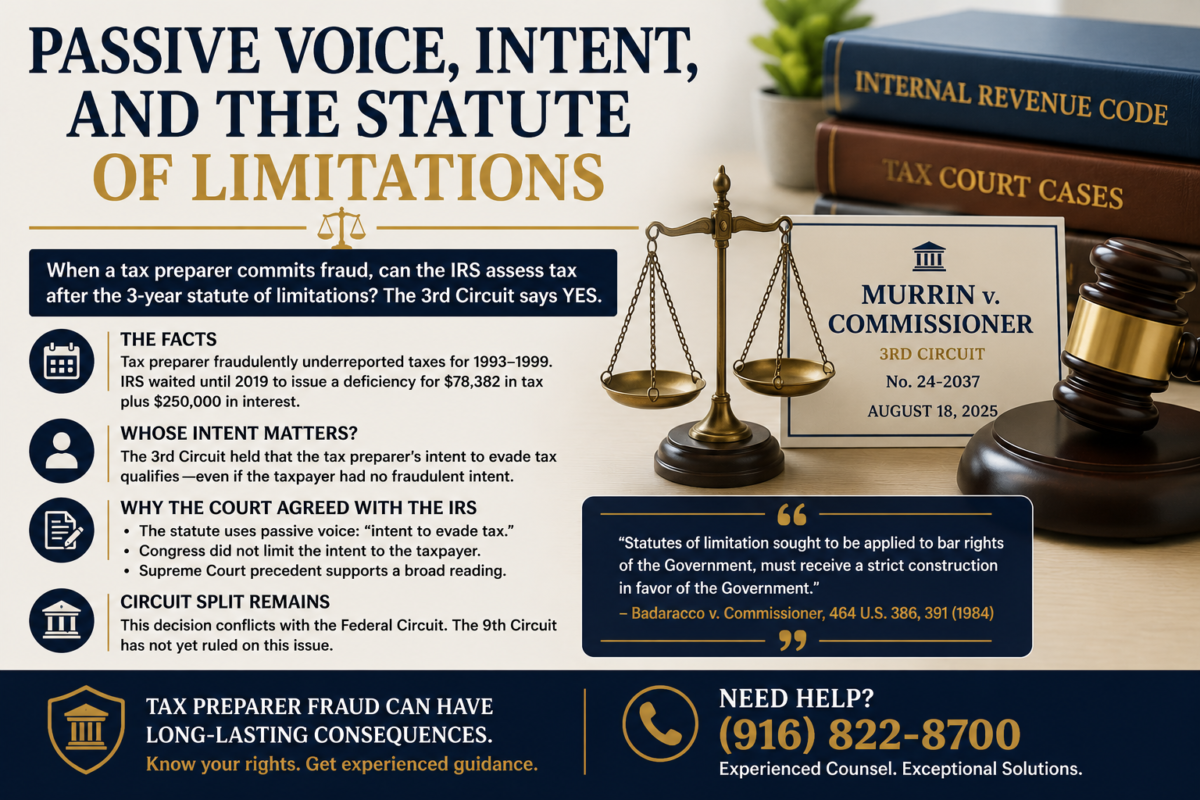
As with many facets of tax law, the question of the statute of limitations has a relatively straightforward answer that generally applies with a dozen exceptions. Fraud is one of the 12 exceptions to the 3-year rule. Specifically: “In the case of a false or fraudulent return with the intent to evade tax, the tax may be assessed, or a proceeding in court for collection of such tax may be begun without assessment, at any time.”[1] Whose intent?
When Ms. Murrin received a notice of deficiency for tax years 1993-1999 in 2019, the decades of delay were justified because their tax preparer committed fraud for these tax years, according to the IRS. For reasons unknown, the parties stipulated that the tax preparer did indeed commit fraud, resulting in underpayment of taxes and associated accuracy penalties. The total amount was $78,382, but interest added another $250,000.
The Third Circuit in Murrin v. Commissioner upheld the Tax Court’s ruling that the tax preparer’s intent qualifies for these purposes. “First, the plain and ordinary meaning of the phrase ‘intent to evade tax’ reveals no taxpayer-only limitation.”[2] Although the tax liability is specific to a person, that specificity is not necessarily transmuted to the intent. The taxpayers are further defeated by the grammatical passive voice. This indicates that “Congress drafted § 6501(c)(1) by focusing on an event that occurs without respect to a specific actor, and therefore without respect to any specific actor’s intent or culpability.”[3] Murrin was particularly influenced by Bartenwerfer v. Buckley,where the Supreme Court explained in the context of bankruptcy law that “[p]assive voice pulls the actor off the stage.”[4] However, the 3rd Circuit refused to “determine the outer bounds of how an ‘intent to evade tax’ applies in every context.”[5]
The taxpayer argued that the most natural reading assigns the intent to the taxpayer whose tax is being evaded and whose return is false. This “argument is a fair one,” the 3rd Circuit conceded. “But the plainest and most straightforward reading of § 6501(c)(1) is that it simply requires an ‘intent to evade tax’ attached to a ‘false or fraudulent return,’ and whether a taxpayer, accountant, lawyer, or tax preparer evinced such intent is beside the point.”[6] The court did not explain why its reading is plainer than the taxpayer’s interpretation. However, the court bolstered its argument by observing that “Congress expressly used the term ‘taxpayer’ in § 6501(a) to define what return is at issue but declined to use the same qualifier in § 6501(c)(1).”[7] The difference in language yields a difference in meaning. The taxpayer’s appeals to other statutory provisions that create individualized responsibility backfired because they only served to prove that Congress is capable of limiting its language to the taxpayer. Contrary to another argument, “our interpretation of § 6501(c)(1) renders nothing superfluous in this statute.”[8]
Together with the Supreme Court’s command that statutes of limitations must be strictly construed in favor of the IRS, the 3rd Circuit easily found in favor of the IRS despite expressions of sympathy for the taxpayer.[9] Nevertheless, the 3rd Circuit recognized that it created a circuit split with the Federal Circuit, noting that the Federal Circuit’s decision came before the Supreme Court’s grammar lesson in Bartenwerfer. As the 3rd Circuit implied, BASR Partnership v. United States did not discuss the passive voice.[10] However, the 3rd Circuit did not point out that BASR Partnership is weakened by three opinions in a three-judge panel. As the Tax Court explained when it considered Murrin v. Commissioner:
Laying out the scorecard: (1) the author of the majority opinion concluded that section 6501(c)(1) ‘suspends the three-year limitations period only when the IRS establishes that the taxpayer acted with the intent to evade tax,’ (2) the author of the concurring opinion reasoned that “it is the taxpayer (or possibly his authorized agent) who must have the requisite ‘intent to evade tax,’ and (3) the author of the dissenting opinion agreed with our holding in Allen.[11]
In any event, the IRS agreed with both sides in its history. In January 2001, it issued FSA 200104006, which limited the intent to that of the taxpayer. Like the taxpayer in Murrin,the IRS argued that the emphasis on fraud connotes the personal responsibility of the taxpayer. The IRS published FSA 200126019 six months later, completely changing its position. This becomes even more curious because both field service advisories were in response to the same fact pattern and were written by the same individual.
The Supreme Court rejected the taxpayer’s appeal of Murrin’s ruling, leaving the circuit split intact. However, the 9th Circuit has yet to opine in this matter, so Murrin is not necessarily binding on Californians. If you suffered from your tax preparer’s fraud, please contact (916) 822-8700 for assistance.
[1] § 6501(c)(1)(emphasis added).
[2] Murrin v. Commissioner, No. 24-2037, 2025 U.S. App. LEXIS 20972, at *5 (3d Cir. Aug. 18, 2025).
[3] Id. at *6(omitting internal quotation mark and brackets).
[4] Bartenwerfer v. Buckley, 598 U.S. 69, 75 (2023).
[5] Murrin v. Commissioner, No. 24-2037, 2025 U.S. App. LEXIS 20972, at *9 n.7 (3d Cir. Aug. 18, 2025).
[6] Id. at *7.
[7] Id. at *8.
[8] Id. at *8-9 (3d Cir. Aug. 18, 2025). The superfluous argument was not well explained, and the court stated that it did not understand it.
[9] “This Court long ago pronounced the standard: ‘Statutes of limitation sought to be applied to bar rights of the Government, must receive a strict construction in favor of the Government.’” Badaracco v. Commissioner, 464 U.S. 386, 391, 104 S. Ct. 756, 761 (1984).
[10] Basr P’ship v. United States, 795 F.3d 1338, 1356 (Fed. Cir. 2015).
[11] Murrin v. Commissioner (T.C. Memo. 2024-10)(omitting internal citations).