
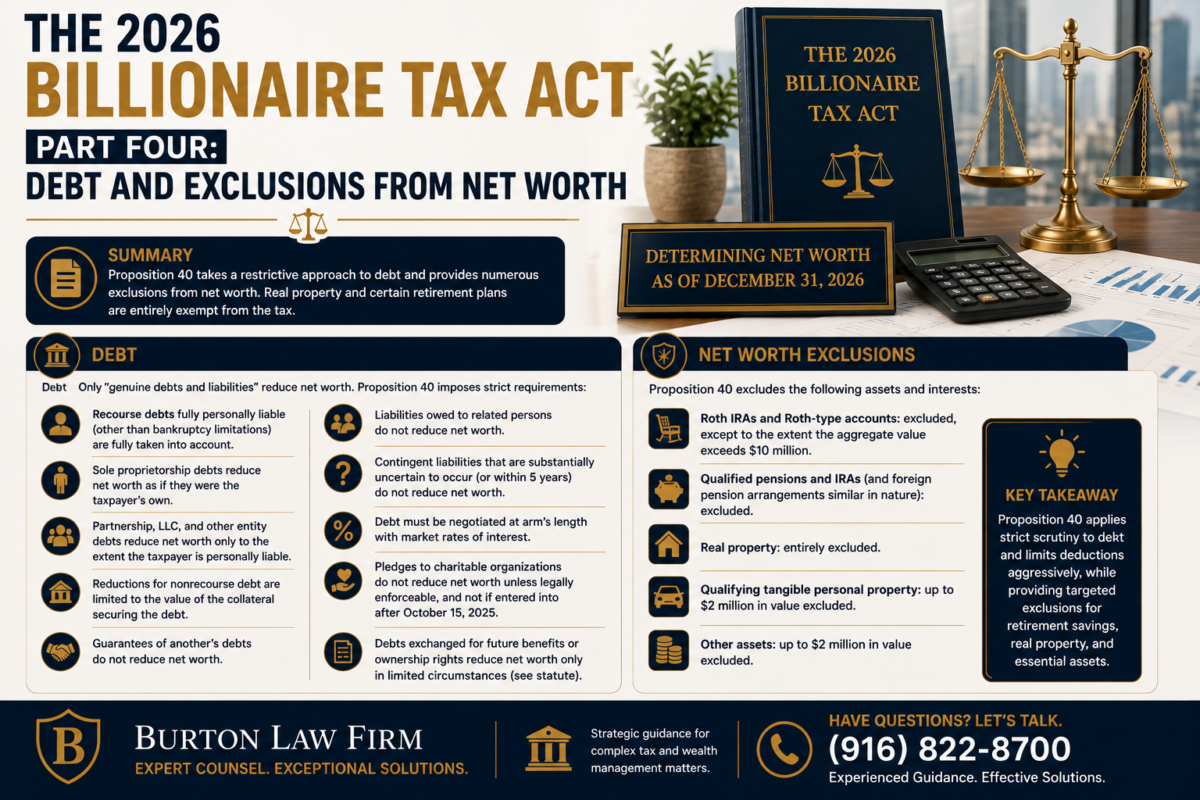
Summary
Welcome to part four of this series on Proposition 40, “The 2026 Billionaire Tax Act.”[1] This part discusses how debt is incorporated into “net worth” and describes the various assets that are excluded from “net worth.” In summary, Proposition 40 is suspicious of debt and imposes strict requirements for any indebtedness to be bona fide in order to impact net worth. Real property and certain retirement plans are entirely exempt from Proposition 40’s tax.
Debt
The 2026 Billionaire Tax Act would take a restrictive view on debt’s role in calculating net worth. Only “[g]enuine debts and liabilities shall be taken into account.”[2] This principle would be enforced through several rules:
- “Recourse debts for which the taxpayer is fully personally liable, without any limitations other than those arising from bankruptcy law, shall be fully taken into account,” except as provided in the subsequent rules.[3]
- “Debts and other liabilities of a taxpayer’s sole proprietorship shall reduce net worth as if they were debts or other liabilities of the taxpayer.”[4]
- “The taxpayer’s net worth shall not be reduced by the amount of debts or other liabilities of a partnership, limited liability company, or other business entity (other than a sole proprietorship) which are allocated to the taxpayer for purposes of computing tax, except to the extent that the taxpayer is personally liable for such debt or other liability.”[5]
- Reductions due to nonrecourse debts “shall not exceed the amounts included in the taxpayer’s net worth on account of the assets serving as collateral for the debt or liability.”[6]
- “A taxpayer’s net worth shall not be reduced by the taxpayer’s guarantee of another’s debts or other liabilities.”[7]
- Net worth would not be decreased for any liability “owed to a related person or persons.”[8]
- Net worth would not be decreased “if the existence or amount of the liability is contingent on future events that are substantially uncertain to occur or that are substantially uncertain to occur within the subsequent five years.”[9]
- Any reduction in net worth due to debt requires the debt to be “negotiated for at arm’s length” with “market rates of interest.”[10]
- “A pledge to make a subsequent contribution to a charitable or philanthropic organization shall not reduce net worth unless such pledge is legally enforceable by the organization to which such contribution is pledged, and in any event no such pledge may reduce net worth if such pledge is entered into after October 15, 2025.”[11]
- “Any debts or liabilities of a taxpayer in exchange for which the taxpayer is entitled to receive future benefits or future ownership rights” may “only reduce net worth” either:[12]
- To the extent that future benefits would be included in the net worth.[13]
- “In the case of a legally enforceable pledge to make a subsequent contribution to a charitable or philanthropic organization, the value of any future benefits received in exchange shall be zero, except to the extent that such benefits would constitute a substantial benefit for purposes of determining the contributor’s charitable contribution deduction.”[14]
- To the extent that “[t]he taxpayer can demonstrate, through clear and convincing evidence, that the amount owed under the debt or liability is in excess of any future benefits or ownership rights that are not included in the taxpayer’s net assets.”[15]
- To the extent that future benefits would be included in the net worth.[13]
Net Worth Exclusions
The 2026 Billionaire Tax Act would offer several exclusions and exceptions to its wealth tax:
- “Amounts held in Roth IRA or other Roth-type retirement arrangements or any substantially similar accounts, except to the extent that the aggregate value in all such accounts in which the taxpayer holds a beneficial interest, either directly or indirectly, exceeds $10 million ($10,000,000) in present value,” would be excluded from the tax.[16]
- Apart from Roth-type retirement arrangements or substantially similar accounts, “qualified pensions and individual retirement arrangements, including those described by Section 219(g)( 5) of the Internal Revenue Code, or foreign pension arrangements similar in nature to those described in that Section and exempted from U.S. taxation by a treaty obligation of the United States” would be excluded from the wealth tax.[17]
- “Nonqualified deferred compensation (other than a contingent profits interest), and any other promises of future payments specified by the Board” that is not described above would be taxed only to the extent that all of the following are true:[18]
- “[T]he taxpayer has a legally binding right as of the end of the tax year to such payment.”[19]
- “The compensation has not been actually or constructively received on or before the end of the year.”[20]
- “Pursuant to the compensation arrangement, the payment is payable to, or on behalf of, the taxpayer on or after the end of the year.”[21]
- “All interests in any real property held directly by a taxpayer or held via a revocable trust shall not be included in net worth.”[22]
- Neither “interests” nor “real property” is defined.
- “Tangible personal property located outside California is excluded if” both of the following are true:[23]
- The property was “located outside California for at least 270 days during 2026.”[24]
- The property was not “relocated temporarily with a substantial purpose of avoiding tax.”[25]
- “In the case of a defined benefit plan,” which is “not otherwise exempt,” the “amount equal to the present value of the taxpayer’s accrued benefit on the last day of the tax year is treated as included by the taxpayer in the taxpayer’s net worth,” while the remainder is excluded.[26]
- The Franchise Tax Board would be directed to “adopt regulations regarding the taxability of receivables and similar assets,” with the power to exempt them based on “whether a taxpayer is reasonably likely to receive payment from a particular type of receivable.”[27]
- However, “all receivables shall be included in net worth” until such regulations are adopted.[28]
- “For all other assets, including art and collectibles, financial instruments other than those that are publicly traded, intellectual property rights, debts and other liabilities owed to the taxpayer (other than those that are publicly traded), and vehicles and other personal property, the taxpayer may exclude up to $5 million ($5,000,000) of total asset value of those assets from net worth and from the reporting requirements.”[29]
- Beyond the $5 million threshold, “a taxpayer must report the fair market value of those assets, and for each asset or group of substantially interchangeable assets (such as derivative contracts relating to the same underlying security) worth in excess of $1 million ($1,000,000), the taxpayer shall submit a certified appraisal.”[30]
[1] Nothing should be construed as support of or opposition to Proposition 40 by the author or The Burton Law Firm.
[2] Proposed RTC § 50302(flush language).
[3] Proposed RTC § 50302(a).
[4] Proposed RTC § 50302(c).
[5] Proposed RTC § 50302(c).
[6] Proposed RTC § 50302(b).
[7] Proposed RTC § 50302(d).
[8] Proposed RTC § 50302(e).
[9] Proposed RTC § 50302(e).
[10] Proposed RTC § 50302(e).
[11] Proposed RTC § 50302(f).
[12] Proposed RTC § 50302(g).
[13] Proposed RTC § 50302(g)(1).
[14] Proposed RTC § 50302(g)(3).
[15] Proposed RTC § 50302(g)(2).
[16] Proposed RTC § 50303(c)(7)(B).
[17] Proposed RTC § 50303(c)(7)(A).
[18] By the literal terms of this provision, it would appear that non-qualified deferred compensation is taxable whether it is payable before, on, or after the end of the year, even far into the future. Proposed RTC § 50303(c)(7)(C).
[19] Proposed RTC § 50303(c)(7)(C)(i).
[20] Proposed RTC § 50303(c)(7)(C)(ii).
[21] Proposed RTC § 50303(c)(7)(C)(iii).
[22] Proposed RTC § 50303(c)(4).
[23] Proposed RTC § 50303(c)(5).
[24] Id.
[25] Id.
[26] Proposed RTC § 50303(c)(7)(E).
[27] Proposed RTC § 50303(c)(8).
[28] Proposed RTC § 50303(c)(8).
[29] Proposed RTC § 50303(c)(9).
[30] Id.