
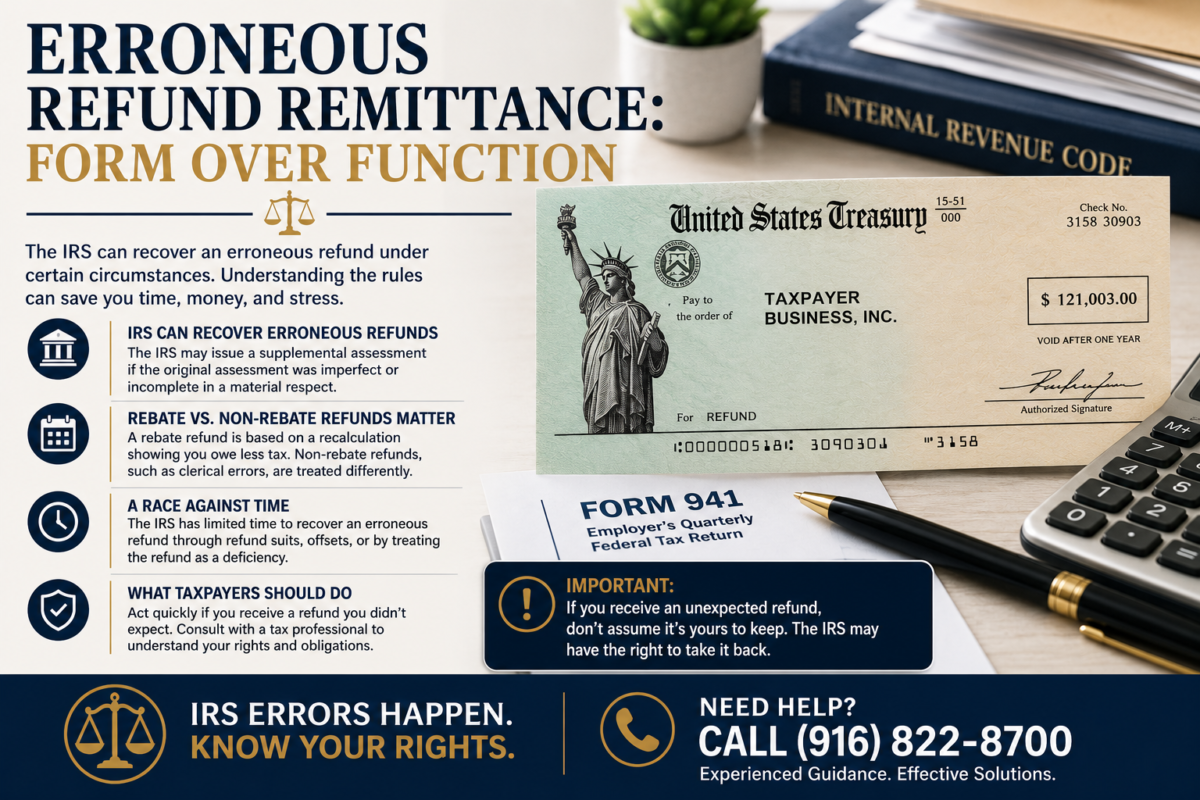
Hough Beck & Baird, Inc. timely filed its Employer’s Quarterly Federal Tax Return (Form 941) and paid $121,003 for the first quarter of 2021. Yet on June 21, 2021, the IRS refunded that amount plus $89 in interest. The taxpayer’s accountant called and was told that the refund was due to “COVID Employee Retention Credits,” which the business apparently did not apply for that period. By May 2023, the IRS demanded that the refund be refunded and made a supplemental assessment of $121,003 plus $12,582 in interest on July 17, 2023.[1] Hough Beck & Baird, Inc. v. Commissioner ruled that the taxpayer must disgorge the amount because the IRS entered the original assessment as $0 instead of double-posting the payment.
“A tax, once correctly assessed and paid, is extinguished.”[2] Yet, the IRS may “make a supplemental assessment within three years after the return was filed,” and “then collect the tax by levy within ten years after a timely reassessment,” if “the original assessment is ‘imperfect or incomplete in any material respect.’”[3] Neither the Internal Revenue Code nor the Treasury Regulations defines “imperfect or incomplete” for these purposes. However, the Tax Court easily found that negating the entire tax liability made “the original assessment imperfect in a material respect.”[4] Although unusual, this fact pattern is not unique. Both the 7th Circuit and the 9th Circuit addressed substantially the same scenario and concluded that the IRS Commissioner could retract the erroneous refund.[5] The Tax Court found these cases “to be almost directly on point and highly persuasive,” and ruled against the taxpayer.[6] Nevertheless, an erroneous refund is a curious case of form prevailing against function with more nuance than this straightforward application implies.
Receiving a refund in error triggers a race against time.[7] The recipient is not entitled to the refund, but the IRS’s time to recover that refund is limited. The IRS has three tools to do so.[8] The first is a refund suit under § 7405 in a district court. That option’s statute of limitations is 2 years unless “it appears that any part of the refund was induced by fraud or misrepresentation of a material fact,” in which case the statute of limitations is 5 years.[9] The second is an administrative offset, withholding amounts otherwise due to the taxpayer from the federal government, such as payments relating to Social Security and tax credits.[10] This is bound by the same statute of limitations applicable to § 7405 lawsuits, except for refunds for both the same tax year and the same tax.[11] The third option is to treat the errant refund as a tax, a “deficiency,” ultimately allowing for extrajudicial levying to collect it (such as garnishing wages). “Section 6211(a) defines a deficiency with the formula: Deficiency = Tax Imposed – (Tax Reported + Prior Deficiency Assessments – Rebates).”[12] The IRS certainly prefers to treat erroneous refunds as deficiencies, both because it does not need to file suit in court and because it generally enjoys a longer statute of limitations, but such treatment is possible only with erroneous rebate refunds. “[S]ince nonrebate refunds do not fit within the definition of a deficiency provided by section 6211, the Commissioner is limited to a refund suit under section 7405 to recover those refunds.”[13] Therefore, the characterization of a refund as a rebate or a non-rebate can effectively determine whether the IRS can recover an erroneous refund through the operation of the statute of limitations.
The Internal Revenue Code “defines a rebate as a refund issued only ‘on the ground’ that the tax imposed should be lower than the tax reported.”[14] The cause of the error is irrelevant for this dichotomy.[15] Instead, a rebate requires “substantive recalculation of the tax imposed that shows the taxpayer owes less tax than the amount shown on the taxpayer’s return.”[16] Thus, simply “writing a refund check to the wrong person” is a non-rebate refund.[17] O’Bryant v. U.S. demonstrates these rules. There, the IRS mistakenly recorded the taxpayer as paying twice, resulting in the refund of the putatively duplicative payment. This was not a supplemental assessment case because the original assessment was correct. Furthermore, it was not a rebate because it did not substantively recalculate the tax liability. “When a taxpayer mails the IRS a check in the full amount of his assessed tax liability, and the IRS cashes it, the taxpayer’s liability is satisfied, and unless a new assessment is made later on, any erroneous, unsolicited refund that the IRS happens to send the taxpayer must be handled on its own terms, not under the rubric of the assessed liability.”[18]
Hough Beck & Baird, Inc. distinguished itself from O’Bryant by observing that in Hough Beck & Baird, Inc.,“the money petitioner received as a result of respondent’s mistaken assessment is the same money petitioner originally owed. Petitioner’s employment tax liability has not been extinguished and remains outstanding.”[19] Nevertheless, the difference is simply a label. Regardless of whether the error occurred because the assessment was entered as zero or the payment was entered twice, the economic result is still the same. However, the label can determine whether the taxpayer can keep the refund. If you received a refund from the IRS in error, please contact us at (916) 822-8700 for assistance.
[1] Although the IRS can charge interest on the illegitimate refund, it likely cannot charge a penalty for the failure to pay. In Brookhurst, Inc. v. U.S., the IRS did not challenge the district court’s judgment holding that the IRS cannot charge failure-to-pay penalties in these situations. Brookhurst, Inc. v. United States, 931 F.2d 554, 555 n.2 (9th Cir. 1991).
[2] Hough Beck & Baird v. Commissioner, No. 19128-24L, 2026 U.S. Tax Ct. LEXIS 1496, at *7 (T.C. July 8, 2026).
[3] Id.
[4] Id. at *9.
[5] United States v. Frontone, 383 F.3d 656 (7th Cir. 2004); Brookhurst, Inc. v. United States, 931 F.2d 554 (9th Cir. 1991).
[6] Hough Beck & Baird v. Commissioner, No. 19128-24L, 2026 U.S. Tax Ct. LEXIS 1496, at *10 (T.C. July 8, 2026).
[7] If the refund is a check, the statute of limitations begins to run when the check is cleared. United States v. Page, 106 F.4th 834 (9th Cir. 2024).
[8] “[T]he IRS is not confined to § 7405 to collect erroneous refunds, but may use any method authorized by the Tax Code.” O’Bryant v. United States, 49 F.3d 340, 343 n.4 (7th Cir. 1995).
[9] IRC § 6532(b).
[10] IRM 21.4.5.15.
[11] PG&E v. United States, 417 F.3d 1375, 1380 (Fed. Cir. 2005); IRM 21.4.5.15(5).
[12] El v. Commissioner, No. 15597-23, 2026 Tax Ct. Memo LEXIS 17, at *5 (T.C. Feb. 10, 2026).
[13] El v. Commissioner, No. 15597-23, 2026 Tax Ct. Memo LEXIS 17, at *7-8 (T.C. Feb. 10, 2026).
[14] Id. At *10 n.3.
[15] “[T]he mechanism of the error does not resolve the issue.” Id. at *13(with reference to computer errors).
[16] Id. at *10-11(omitting internal quotation mark).
[17] United States v. Frontone, 383 F.3d 656, 661-62 (7th Cir. 2004).
[18] O’Bryant v. United States, 49 F.3d 340, 347 (7th Cir. 1995).
[19] Hough Beck & Baird v. Commissioner, No. 19128-24L, 2026 U.S. Tax Ct. LEXIS 1496, at *11 (T.C. July 8, 2026)(omitting internal citation).