
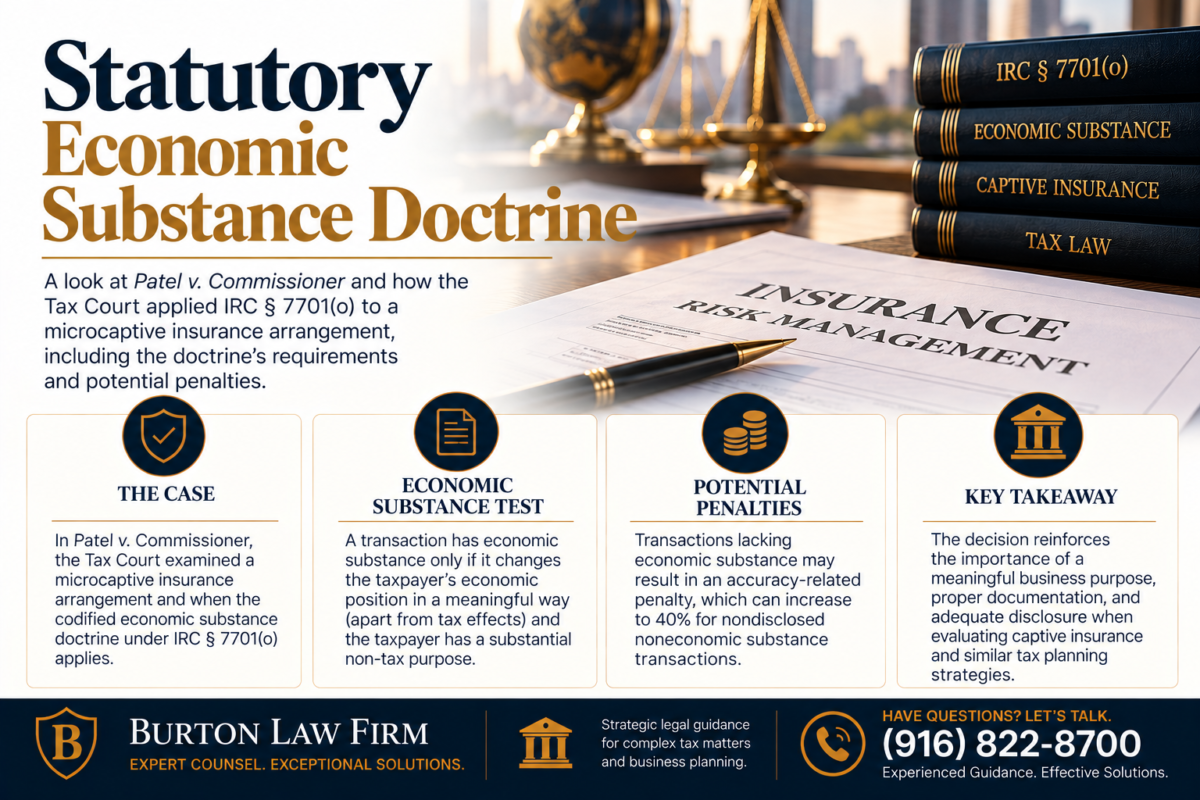
In 2010, Congress codified the economic substance doctrine in § 7701(o) of the Internal Revenue Code.[1] Patel v. Commissioner “is the Court’s first opportunity to examine when the codified economic substance doctrine applies.”[2] The taxpayers engaged in a microcaptive insurance company scheme to avoid taxes. They did not engage in any “feasibility study to determine the costs and merits of a captive arrangement,” and they did not “explore[] the cost and availability of the same policies on the commercial market.”[3] They used ordinary commercial insurance for their bona fide businesses at a cost of between $68,000 and $106,000 while choosing to pay nearly $1.2 million in annual premiums to their microcaptive insurance company (at the time $1.2 million was the limit for favorable § 831(b) treatment). Yet one purported reason for the microcaptive insurance company was to insure their businesses. Worst of all, the taxpayers’ emails were quite explicit regarding the tax avoidance purpose. Two prior Tax Court opinions already determined that the insurance deductions were disallowed. Now, the issue was whether any penalties applied.
Section 6662 lists ten grounds for an accuracy-related penalty on underpayments. “Only one accuracy-related penalty may be applied with respect to any given portion of an underpayment, even if that portion is penalizable on more than one of the grounds set forth in section 6662(b).”[4] One of these is the “accuracy-related penalty on the portion of an underpayment of tax required to be shown on a return attributable to the disallowance of claimed tax benefits by reason of a transaction lacking economic substance within the meaning of section 7701(o).”[5] This is an important penalty because its rate doubles to 40% if “the relevant facts affecting the tax treatment are not adequately disclosed in the return nor in a statement attached to the return.”[6] Such a transaction is termed a “nondisclosed noneconomic substance transaction.”[7] The 40% penalty has § 7701(o) applicability as a necessary, but not sufficient, condition.
Turning to § 7701(o), the Tax Court “easily conclude[d] that the statute requires a relevancy determination. To put it plainly—the statute says so, right there, on its face.”[8] Furthermore, this relevancy determination was preliminary and apart from the two-part test contained in the statute. This is determined “as if the statute had never been enacted.”[9] Here, the Tax Court found plenty of caselaw before 2010 applying the doctrine to captive insurance cases and concluded that it was relevant. Therefore, economic substance can be found only when “the transaction changes in a meaningful way (apart from Federal income tax effects) the taxpayer’s economic position, and the taxpayer has a substantial purpose (apart from Federal income tax effects) for entering into such transaction.”[10]
There was “a circular flow of funds” between the insurer and the insured, controlled by related parties to the extent that there was not a meaningful economic change for the taxpayers.[11] The tax purpose was all but admitted through the emails. Yet the conclusion was still otherwise inevitable, given that the “premiums were not set by actuarial principles, but by their only customer whose expressed interest was in paying the maximum deductible amount” and who “sat on both sides of the transactions” by “doubling as [the insurance company’s] sole customer and founder.”[12] There were many other facts unfavorable to the taxpayer in a profusion of discrepancies seemingly designed by a law professor to create an exam question with an easy answer.
Section 6662(b)(6) imposes a penalty on the occurrence of: “Any disallowance of claimed tax benefits by reason of a transaction lacking economic substance (within the meaning of section 7701(o)) or failing to meet the requirements of any similar rule of law.” Patel next pondered the meaning of “by reason of.” “The most natural reading of this statute is that a lack of economic substance must be the cause of the disallowance of the claimed tax benefit (here, deductions for purported insurance premiums).”[13] The Tax Court further equated “by reason of” with “because of” in the English language.[14] Strikingly, the notices of deficiencies imposed the § 6662(b)(6) penalty yet forbore from disallowing the deductions giving rise to the penalty. These were disallowed only through the IRS’s pleadings in Tax Court. The penalty increase from 20% to 40% also only occurred through such pleadings. “[W]here the Commissioner asserts a new matter, such as a penalty, in an answer (rather than in the NOD), the Commissioner bears the full burden of proof regarding the penalty, including the taxpayer’s lack of reasonable cause or any other applicable affirmative defense.”[15] The absence of economic substance was well proven.
The 40% nondisclosed noneconomic substance transaction penalty requires the lack of disclosure. For the Tax Court, “[t]his is our first opportunity to consider what constitutes adequate disclosure under section 6662(i)(2).”[16] However, the court simply adopted caselaw regarding adequate disclosure in other contexts. This is a question of fact requiring disclosure to “be sufficiently detailed to alert the Commissioner and his agents as to the nature of the transaction so that the decision as to whether to select the return for audit may be a reasonably informed one.”[17] Slightly more specifically, “[t]he disclosure must be more substantial than providing a clue that would intrigue the likes of Sherlock Holmes but need not recite every underlying fact.”[18] Again, this requirement was clearly wanting. Unfortunately, the Tax Court did not describe or even indicate what might have been sufficient disclosure for these purposes. The remaining penalties (the 40% percent penalty was not sought for all years) were imposed with ease. Notably, the taxpayer’s characterization of himself as a “savvy financial person” who did not need tax advice undermined his attempt to claim reliance on a tax professional as a defense
There are certain tantalizing aspects of Patel v. Commissioner. One is the recognition of the preliminary requirement’s existence. “Congress could hardly have been clearer, at least on this narrow point.”[19] The Tax Court did not explain how relevance is determined, but did so by reviewing caselaw. It is unclear whether there is another means for finding relevance. The statute itself provides that it “[t]he determination of whether the economic substance doctrine is relevant to a transaction shall be made in the same manner as if this subsection had never been enacted.”[20] Yet limiting relevance based on caselaw prior to codification may allow an entirely novel question to escape the statutory economic substance doctrine’s grasp. For now, this appears to be the sole clue on the map toward the realm where economic substance is irrelevant.
The Tax Court treated the penalty in question as if entirely dependent on the statutory economic substance doctrine. Yet that is incorrect. The statute permits the violation of “any similar rule of law” to the statutory economic substance doctrine to be an alternative for the purpose of imposing the penalty. The Tax Court quoted the pertinent statutory language, but otherwise ignored what a “similar rule of law” may mean. Yet the most intriguing part of Patel was the least explained.
The Tax Court observed that one of the taxpayers “transferred ownership of these entities to his children so that assets would pass outside of his taxable estate.”[21] It further noted that the taxpayers “did not argue that their estate planning objective gave their microcaptive arrangement economic substance; we likewise restrict our analysis to the microcaptive transaction and its income tax effects.”[22] Patel v. Commissioner took pains to be thorough, pointedly explaining its holdings in full for multiple reasons even when one would be enough. It had the patience to address each of the taxpayer’s arguments in considerable detail, whether hidden in a footnote to a responsive pleading or nearly frivolous (e.g., claiming that the taxpayers were “Congressionally induced” into the tax scheme and therefore justified). The statutory version of the economic substance doctrine only applies to Subtitle A—estate taxation is in Subtitle B. It is unlikely that the Tax Court suggested that Subtitle B taxes are exempt from the common law version. Instead, perhaps, since the penalty provision was pegged by the court to the definition of economic substance to § 7701(o), which in turn is limited to Subtitle A (income) taxes, the taxpayers might have had a creditable argument had they claimed that estate tax avoidance was a sufficient non-income tax reason.
Section 7701(o) is a powerful tool for the IRS with a powerful exception. Therefore, it is perplexing that the exception was not addressed. “In the case of an individual, [the statutory economic substance doctrine] shall apply only to transactions entered into in connection with a trade or business or an activity engaged in for the production of income.”[23] Here, the taxpayer did not operate the microcaptive insurance company for income. That was a significant reason why there was not any economic substance to the scheme. Furthermore, it is well established that “to be engaged in a trade or business, the taxpayer must be involved in the activity with continuity and regularity and that the taxpayer’s primary purpose for engaging in the activity must be for income or profit.”[24] It would appear that the taxpayer left a cogent argument forlorn.
If the IRS accuses you of conducting your affairs without economic substance, please call 916-822-8700 or email info@lawburton.com.
[1] “In relevant part, section 7701(o) provides:
Sec. 7701(o). Clarification of economic substance
doctrine.—
(1) Application of doctrine.—In the case of any transaction to which the economic substance doctrine is relevant, such transaction shall be treated as having economic substance only if—
(A) the transaction changes in a meaningful way (apart from Federal income tax effects) the taxpayer’s economic position, and
(B) the taxpayer has a substantial purpose (apart from Federal income tax effects) for entering into such transaction.
. . . .
(5) Definitions and special rules.—For purposes of this subsection–
(A) Economic substance doctrine.—The term “economic substance doctrine” means the common law doctrine under which tax benefits under subtitle A with respect to a transaction are not allowable if the transaction does not have economic substance or lacks a business purpose.
(B) Exception for personal transactions of individuals.—In the case of an individual, paragraph (1) shall apply only to transactions entered into in connection with a trade or business or an activity engaged in for the production of income.
(C) Determination of application of doctrine not affected.—The determination of whether the economic substance doctrine is relevant to a transaction shall be made in the same manner as if this subsection had never been enacted.
(D) Transaction.—The term ‘transaction’ includes a series of transactions.” Patel v. Commissioner, 165 T.C. No. 10 (2025) at *15-16.
[2] Id. at *16.
[3] Id. at *6.
[4] Id. at *30.
[5] Id. at *13.
[6] IRC § 6662(i)(2).
[7] Id.
[8] Patel v. Commissioner, 165 T.C. No. 10 (2025) at *17.
[9] Id.
[10] § 7701(o)(1).
[11] Patel v. Commissioner, 165 T.C. No. 10 (2025) at *23.
[12] Id. at *25.
[13] Id. at *27.
[14] Id.
[15] Id. at 11-12.
[16] Id. at 29.
[17] Id.
[18] Id.
[19] Id. at 17.
[20] § 7701(o)(5).
[21] Patel v. Commissioner, 165 T.C. No. 10 (2025) at *23-24.
[22] Id. at *24 n.17.
[23] § 7701(o)(5)(B).
[24] Commissioner v. Groetzinger, 480 U.S. 23, 35 (1987)(Analyzing the term in a different context).