
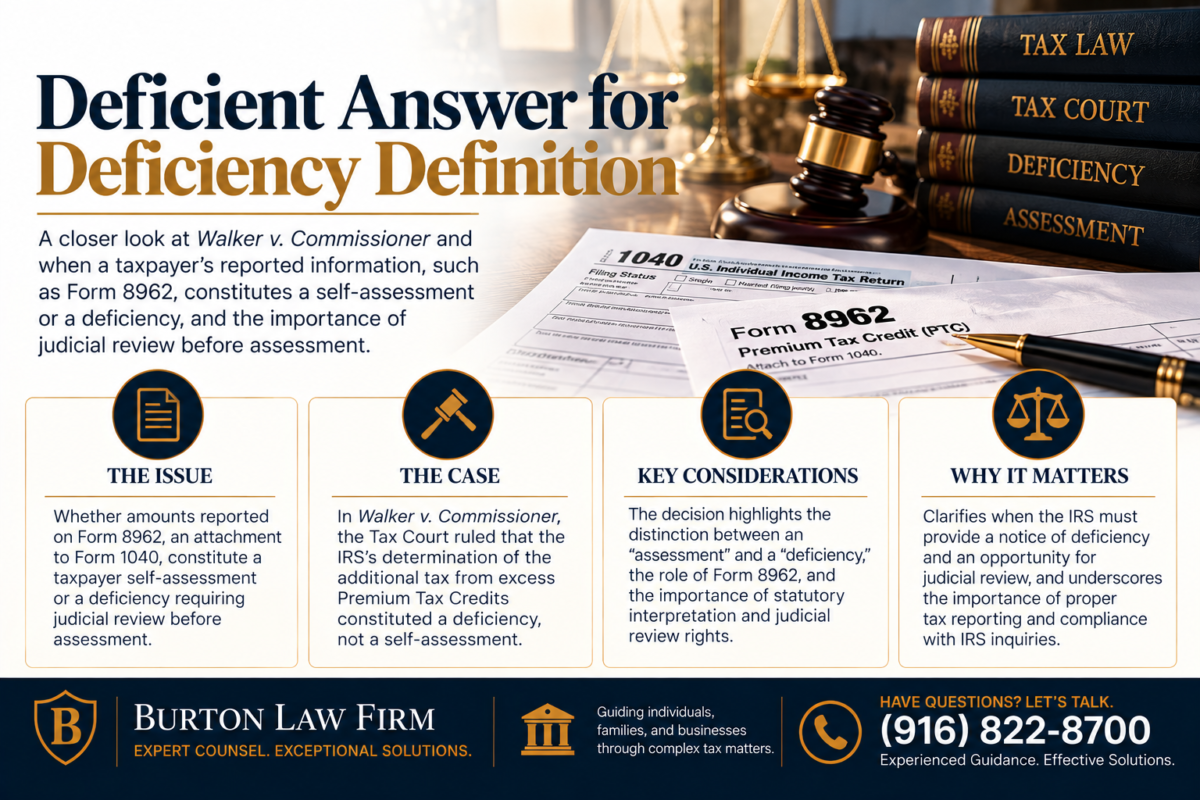
One of the most important rights a taxpayer enjoys is the opportunity of judicial review before a “deficiency” is “assessed.”[1] “Assessment is the formal recording of a taxpayer’s tax liability.”[2] Deficiency has a longer meaning. “The Code defines a deficiency as the amount by which the income, gift, estate, or excise tax imposed exceeds the excess of the sum of the amount shown as the tax by the taxpayer upon his return plus any previously assessed amounts, over the amount of rebates made.”[3] In Walker v. Commissioner, taxpayers erroneously claimed and received an excess Premium Tax Credit amount of $20,904 for the 2018 tax year. This was reported on Form 8962, an attachment to Form 1040, upon request by the IRS in 2019 because it was missing from the original 2018 tax return. The IRS claimed that this constituted a taxpayer-reported tax, obviating the need for a deficiency notice before assessing that amount. Form 8962 functions as the reconciliation of the advance Premium Tax Credit (APTC) amount with the allowable amount. The excess is treated as tax due. The Tax Court ruled in favor of the taxpayers. Unfortunately, its reasoning was rather parsimonious:
Form 8962, however, does not ultimately determine an amount of tax due from petitioners. Furthermore, petitioners’ return, as originally filed, failed to account for the PTC. Therefore, and upon receipt of information received in Form 8962, it was necessary for the IRS to determine whether petitioners had a deficiency in tax… We decline to accept the notion that this reconciliation acts as a self-assessment of additional tax. See, e.g., I.R.C. §36B(f)(2)(B) (limiting the amount of any tax due upon receipt of excess APTC to $600, $1,500, or $2,500, depending on the percentage of the taxpayer’s household income above the poverty line). Considering the specific wording of section 36B(f), we conclude that the IRS determined that petitioners owed additional tax notwithstanding their original filing, which is the quintessential definition of a deficiency.[4]
It is unclear what part of the “specific wording of section 36B(f)” prevented this reconciliation from being a self-assessment. The given example did not apply here. The limitation of repayment, which has since been repealed, is applicable only to certain income levels that the taxpayers exceeded—they were obliged to repay the excess amount in full.
Seemingly, the Tax Court is treating self-assessment in a manner reminiscent of self-incrimination—narrowly construed in the taxpayer’s favor and compliant with formalities to be valid. Technically, the amount given as excess APTC need not be part of the tax owed. It is possible that such amounts could be reduced by credits. Line 24 of Form 1040 states with emphasis: “This is your total tax.” Is the Tax Court claiming that self-assessment must be so explicit? In addition, the Tax Court emphasized that the original return lacked the owed tax and that Form 8962 was filed only in response to explicit prompting by the IRS. Is the Tax Court suggesting that compliance with an IRS inquiry is not a self-assessment? Is it the combination of the two circumstances? In another facet, the Tax Court declared after giving the definition of “deficiency”: “On the basis of the foregoing plain text of the Code, we find that petitioners’ legal argument that the Assessment is a deficiency determination under the Code is well supported.”[5] This was written before the Tax Court analyzed § 36B(f) regarding the APTC, suggesting that § 36B(f) was not necessarily determinative.
There is little caselaw regarding when an amount is self-assessed for the purposes of deficiency lexicology. This makes Walker v. Commissioner’s vagaries all the more perplexing. Apparently, the result was nearly self-evident to the Tax Court. Overall, it appears that this rule provides that amounts outside the main body of Form 1040 or equivalent tax return are presumed not to be self-assessment for the purposes of defining “deficiency.” Although not explicitly stated, the IRS is likely barred by the statute of limitations from properly assessing the amount that the taxpayer conceded.
If the IRS wrongly assesses a deficiency before an opportunity for judicial review, please call 916-822-8700 or email info@lawburton.com.
[1] § 6213(a).
[2] Walker v. Commissioner, No. 2801-24L, 2026 Tax Ct. Memo LEXIS 4, at *12 n.9 (T.C. Jan. 8, 2026)(omitting internal quotation mark).
[3] Walker v. Commissioner, No. 2801-24L, 2026 Tax Ct. Memo LEXIS 4, at *12 (T.C. Jan. 8, 2026)(omitting internal quotation marks, brackets, and ellipses).
[4] Walker v. Commissioner, No. 2801-24L, 2026 Tax Ct. Memo LEXIS 4, at *11 & 13 (T.C. Jan. 8, 2026).
[5] Walker v. Commissioner, No. 2801-24L, 2026 Tax Ct. Memo LEXIS 4, at *13 (T.C. Jan. 8, 2026).