
Background: Another Limited Partners Case
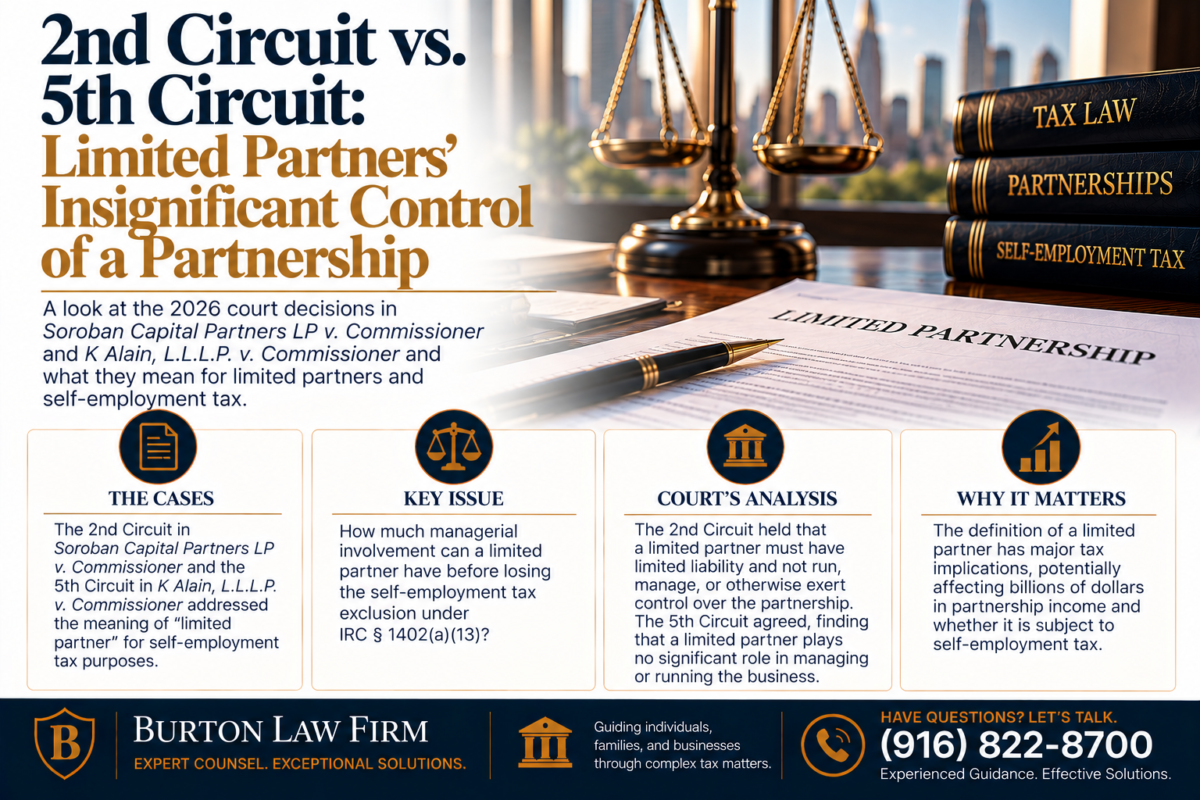
The year 2026 has displayed an unusual focus on the meaning of “limited partners.” First, in January, the 5th Circuit held that a “limited partner” is simply a limited partner in a state-law limited partnership that is afforded limited liability.”[1] Then the 5th Circuit changed its mind in the same case, K Alain, L.L.L.P. v. Commissioner, in August. The proper meaning instead “is a partner who plays no significant role in managing or running a business.”[2] The 2nd Circuit joined the discussion in September with Soroban Capital Partners LP v. Commissioner: “[A] ‘limited partner’ is one who has limited liability and who does not run, manage, or otherwise exert control or managerial authority over the partnership.”[3] Denham Cap. Mgmt. LP v. Commissioner is a further case on the definition of “limited partners” that may be decided this year, this time by the 1st Circuit. The meaning is worth billions of dollars because while “self-employment income generally includes—and the self-employment tax generally applies to—the distributive shares partners receive from their partnerships,” “there shall be excluded the distributive share of any item of income or loss of a limited partner, as such, other than guaranteed payments” for services rendered.[4] Income received by virtue of being a limited partner is not self-employment income.
The 5th Circuit’s opinion in Alain was written in large part as the disapproval of the Tax Court’s definition of a “limited partner” as a “passive investor” in Soroban.[5] Alain was quite critical: “With just a few sentences of operative analysis—citing no contemporary textual authority—the Tax Court insisted that ‘limited partner, as such’ somehow denoted more than limited liability. The Tax Court then said, without significant analysis, that this required a ‘passive investor’ rule. The Tax Court made no attempt to ground its rule in the original public meaning of ‘limited partner’ in 1977.”[6] On appeal 2nd Circuit upheld the Tax Court’s decision in Soroban and provided the analysis that the 5th Circuit found was lacking in the Tax Court’s opinion.
Reasoning of Soroban
“We begin, as always, with the text.”[7] However, “[b]ecause the Code does not define the term ‘limited partner,’ we apply the usual methods of statutory interpretation.”[8] This means “consider[ing] contemporaneous dictionary and treatise definitions of ‘limited partner,’ as well as contemporaneous state statutes regarding limited partnerships, to discern the term’s ordinary meaning at the time of § 1402(a)(13)’s enactment,” which was 1977.[9] Reviewing multiple dictionaries, the court concluded that “a limited partner was understood in 1977 to have two features: limited liability and lack of managerial control over the partnership.”[10] Contemporaneous treatises reinforced the court’s opinion “that an essential feature of the limited partner in 1977 was a lack of participation in running the partnership’s business.”[11]
Since “Congress is presumed to legislate with familiarity of the legal backdrop for its legislation,” Soroban next focused on how states defined “limited partner.”[12] “[I]n 1977, the majority of states allowed partners to maintain their limited liability only to the extent that they did not exercise managerial control over the partnership.”[13] The taxpayers countered “that some states allowed limited partners to participate in control of the business and maintain limited liability, or otherwise did not premise the definition of ‘limited partner’ on the absence of managerial control.”[14] This did not impact the “ordinary meaning” according to the court. “Were we to adopt Soroban’s position that a term’s meaning may only be ‘ordinary’ if it is universally and identically adopted across all 50 states, we doubt that any word could have such an ‘ordinary’ meaning.”[15] Soroban rejected a state-by-state approach because “[s]tate law may control only when the federal taxing act, by express language or necessary implication, makes its own operation dependent upon state law.”[16] Nevertheless, a “limited partner” is a concept governed by state law and Soroban already relied on the deemed consensus of state law for its definition of “limited partner.”
The words “as such” appear in the statute immediately after “limited partner.” “The phrase ‘as such’ means ‘in that capacity.’”[17] Soroban argued that “[i]t therefore limits the tax exclusion to income a partner earns in their capacity as a limited partner — that is, income attributable to the partner’s investment in the partnership, not to their management of the business.”[18] In contrast, the 5th Circuit declined to analyze the impact of the words “as such.” If the term “limited partner” meant a passive partner, especially with the phrase “as such,” this could make the statutory clarification that guaranteed payments “for services actually rendered” are included as self-employment income superfluous.[19] However, “the carveout aligns with the paradigm that income from working (as opposed to investing) is subject to the self-employment tax.”[20] The court agreed that a limited partner “could provide some services to the partnership,” but “merely providing services does not necessarily equate to running the business.”[21] Therefore, “the inclusion of guaranteed payments in the definition of ‘self-employment income’ shows that in 1977, Congress omitted from the term ‘limited partner’ any partner with management authority over the partnership.”[22] This conforms with the rest of the statutory section which explains that “[i]tems such as real estate rental income, stock dividends and interest on bonds, and gains from the sale or exchange of capital assets or property are excluded—but only if they are not the product of a trade or business in those areas.”[23] Consequently, “[t]his additional statutory text makes clear the distinct treatment of income from investment and income from employment—that is, from work.”[24]
Soroban next looked at the legislative history. “Before 1977, all partners’ partnership income qualified as selfemployment [sic] income subject to the self-employment tax,” and “all partnership income also triggered eligibility for Social Security benefits.”[25] This was abused by some whereby “[t]he would pay these passive investors small distributions as a return on their investments, the passive investors would pay small amounts of the selfemployment [sic] tax on those distributions, and the passive investors would in turn earn Social Security credits for those tax payments.”[26] The result was the payment of Social Security benefits due to “mere passive investment.”[27] Congress’s solution was to “change[] the Social Security Act so that the distributive shares of limited partners (that is, partners who functioned as passive investors) no longer counted toward Social Security benefits.”[28] This created a new “loophole,” in which partners “manag[e] the partnership in exchange for large distributions, which they claimed were not subject to the self-employment tax on account of their ‘limited-partner’ status.”[29] This contravened the intent of the statute, according to the court, which cited a congressional report “accompanying the Social Security Amendments of 1977 described the type of income excluded from NESE [net earnings from self-employment]—and therefore ‘excluded from social security coverage’—as earnings that are ‘basically of an investment nature.’”[30]
The 2nd Circuit easily rejected the taxpayers’ other arguments. They cited other instances in the Internal Revenue Code wherein the passive nature of the limited partner is more explicit, such as § 469(h)(2) stating that for the purposes of that section, “[e]xcept as provided in regulations, no interest in a limited partnership as a limited partner shall be treated as an interest with respect to which a taxpayer materially participates.” However, further clarification would have been “redundant” according to Soroban. “[W]e do not require Congress to repeat itself several times over before we give its words effect.”[31]The Social Security Administration finalized regulations in 1978 “partially defin[ing] a limited partner as ‘one whose liability with respect to the obligations of the partnership is limited to the amount of his or her financial investment in the partnership.’”[32] Yet reliance on this provision backfired for the taxpayers because “that regulation also notes that ‘[g]enerally, [a limited partner] will not have performed services in the operation of, or participated in the control of, the business carried on by the partnership for the taxable year involved.’”[33] Similar administrative materials published by the same agency subverted the taxpayers’ position for the same reason. In contrast, the instructions published by the IRS defined limited partners for decades simply as partners with limited liability without mention of management. This history of agency interpretation was influential for the 5th Circuit. But here, the 2nd Circuit rebuffed that “[a]n incomplete definition of ‘limited partner’ in the IRS’s Form 1065 instructions cannot overcome” the statute’s plain meaning.[34] In 1997, the IRS proposed regulations excluding partners with an active role (with specific criteria) from the meaning of “limited partners.” Congress responded by forbidding the IRS from finalizing any regulation regarding this definition until July 1, 1998. The IRS declined to do so even after this date. To Soroban,this meant that “Congress chose to leave § 1402(a)(13) untouched—thereby preserving the definition of ‘limited partner’ as it was commonly understood in 1977, when § 1402(a)(13) was passed.”[35]
Conclusion
Ultimately, a limited partner may provide some services to the partnership. “So long as the activities in question do not constitute controlling, managing, or running the business, a partner may play a role in the partnership and still qualify as ‘limited’ under § 1402(a)(13).”[36] However, it remains unclear when that line is crossed. The facts of Soroban offer little aid because the taxpayers effectively conceded that the limited partners in question managed the partnership. Soroban avoided any recognition of conflict with the 5th Circuit, stating that “to the extent K Alain holds that a limited partner may provide some services to the partnership, we do not disagree. Nor does the Commissioner.”[37] Indeed, Soroban seemed eager to reconcile the 5th Circuit with itself, the IRS, and the Tax Court, even implying that the 5th Circuit might have misread the Tax Court’s opinion in Soroban.[38] Yet the fact remains that the 2nd Circuit standard is that “a ‘limited partner’ is one who has limited liability and who does not run, manage, or otherwise exert control or managerial authority over the partnership.”[39] In contrast, the 5th Circuit definition “is a partner who plays no significant role in managing or running a business.”[40] Lamentably, the 2nd Circuit does not explore whether its omission of “significant” in its definition means that a partner with an insignificant role in managing or running a business is no longer a limited partner.
[1] Sirius Sols. L.L.L.P. v. Commissioner, 165 F.4th 374, 388 (5th Cir. 2026) withdrawn by Alain v. Commissioner, No. 24-60240, 2026 U.S. App. LEXIS 24366 (5th Cir. Aug. 12, 2026).
[2] K Alain, L.L.L.P. v. Commissioner, 184 F.4th 766, 767 (5th Cir. 2026).
[3] Soroban Capital Partners LP v. Commissioner, Nos. 25-2079 (L), 25-2250 (CON), 2026 U.S. App. LEXIS 28448, at *51 (2d Cir. Sep. 17, 2026).
[4] Id. at *6-7; I.R.C. § 1402(a)(13).
[5] K Alain, L.L.L.P. v. Commissioner, 184 F.4th 766, 771 (5th Cir. 2026).
[6] Id.(omitting internal citations; emphases added by the 5th Circuit).
[7] Soroban Capital Partners LP v. Commissioner, Nos. 25-2079 (L), 25-2250 (CON), 2026 U.S. App. LEXIS 28448, at *27 (2d Cir. Sep. 17, 2026).
[8] Id.
[9] Id. at *27-28.
[10] Id. at *29.
[11] Id. at *31-32.
[12] Id. at *33.
[13] Id.
[14] Id. at *34.
[15] Id. at *35.
[16] Id.(quoting Burnet v. Harmel, 287 U.S. 103, 110 (1932)(brackets added by the court)).
[17] Id. at *36.
[18] Id.(emphasis in original).
[19] IRC § 1402(a)(13).
[20] Soroban Capital Partners LP v. Commissioner, Nos. 25-2079 (L), 25-2250 (CON), 2026 U.S. App. LEXIS 28448, at *37 (2d Cir. Sep. 17, 2026).
[21] Id.(emphasis in original).
[22] Id. at *37-38.
[23] Id. at *39.
[24] Id. at *38-39.
[25] Id. at *40.
[26] Id.
[27] Id. at *41.
[28] Id.
[29] Id. at *42.
[30] Id. at *42-43.
[31] Id. at *44.
[32] Id. at *47.
[33] Id.(brackets added by the court).
[34] Id. at *49.
[35] Id. at *50.
[36] Id. at *52.
[37] Id. at *51-52.
[38] According to the Second Circuit:
The Fifth Circuit explicitly rejected the Tax Court’s decision in this case, which it described as holding that “the term ‘limited partner’ could refer only to ‘passive investors.” We need not decide whether the Fifth Circuit’s parsing of Soroban I, 161 T.C. 310, is accurate. We do observe, however, that if our reading of K Alain is correct, there appears to be little daylight between the Fifth Circuit’s position and the Tax Court’s holding in Soroban II that a limited partner is one who acts “generally akin to [a] passive investor[].” Id. at *52 n.16(omitting internal citations, brackets and emphasis in the 2nd Circuit’s opinion).
[39] Id. at *51.
[40] K Alain, L.L.L.P. v. Commissioner, 184 F.4th 766, 769 (5th Cir. 2026)(emphasis added).