
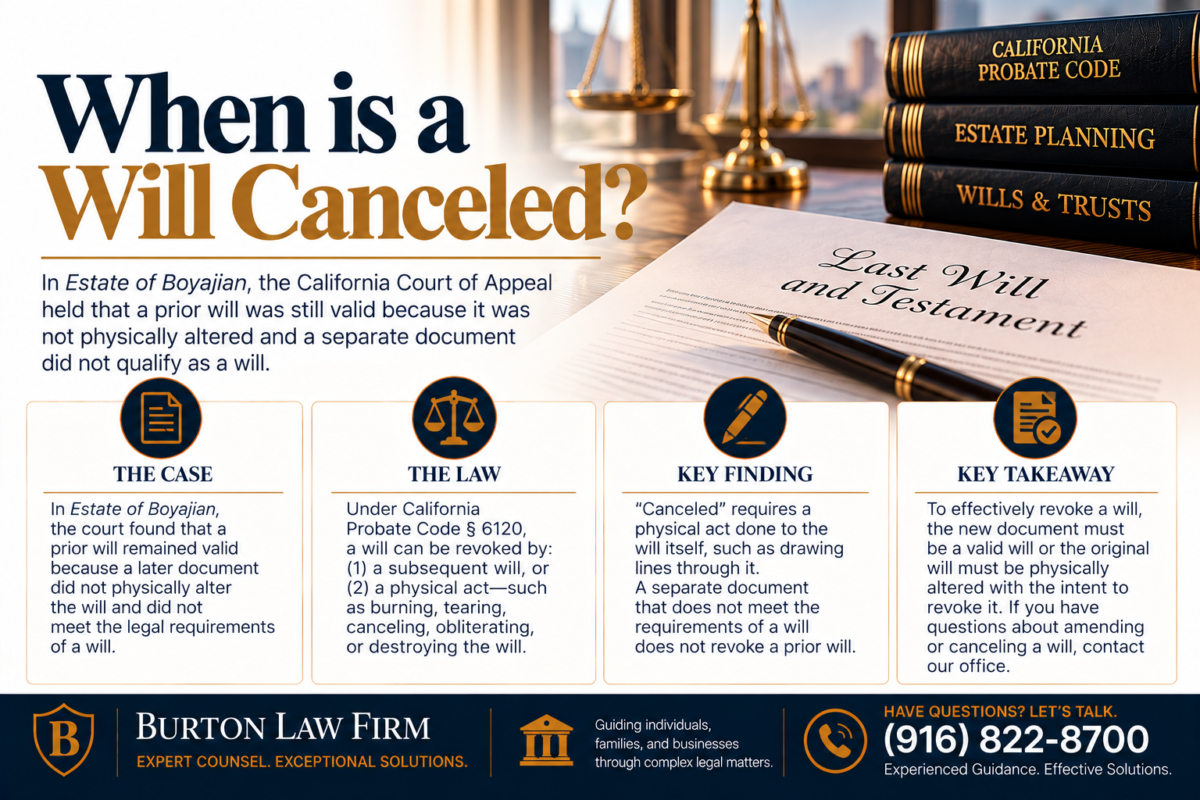
In 2018, Ms. Boyajian signed a document purporting to revoke certain prior documents, including her 2006 will, yet without visiting violence upon the 2006 will. In Estate of Boyajian, the California Court of Appeal held that the 2006 will was still valid because it was not physically altered, and the 2018 document did not constitute a will. The relevant statute is Probate Code § 6120, providing two means for revoking a will:
- “A subsequent will which revokes the prior will or part expressly or by inconsistency.”
- The will “[b]eing burned, torn, canceled, obliterated, or destroyed, with the intent and for the purpose of revoking it, by either (1) the testator or (2) another person in the testator’s presence and by the testator’s direction.”
The question was the meaning of “canceled.” Acknowledging the breadth of potential meanings, the court nevertheless explained that “back in the Gilded Age, our high court gave ‘cancel’ a narrow, hypertechnical sense.”[1] In 1898, the California Supreme Court explained that: “One of the recognized modes of revoking a will is by cancellation. In its primal significance the word means a lattice work. As applied to writings, it means the nullification of a writing by drawing upon its face lines in the form of a lattice work, ‘crisscross.’”[2] While asserting that the precedent alone is sufficient, Estate of Boyajian offered independent reasons. Section 6120 is an adoption of § 2-507 of the Uniform Probate Code, and California’s Probate Code § 2 requires conformity.[3] The official commentary to the Uniform Probate Code explains that: “Revocation of a will may be by either a subsequent will or an authorized act done to the document.”[4] A separate document is not something “done to the” prior will. This accords with the 1677 Statute of Frauds of England, permitting revocation by a “revocatory act,” including “burning, canceling, tearing, or obliterating the will.”[5] Furthermore, since the words surrounding “canceled” are physical in nature, that term must be physical as well.
The court admits that the rule requiring a physical act done to the revoked will instrument is “perhaps in need of revisiting,” but it is the rule nevertheless.[6] Therefore, the 2006 will is valid unless the 2018 document amounts to a will itself. Since [i]t does not transfer or dispose of any property upon Layla’s death,” among other fatal deficiencies, it is not a will.[7] This rule may pose problems in situations where a will is lost but may be found later. A curative may be found in the fact that Estate of Boyajian did not comment on the scope of the subsequent will; it simply must be a valid will. Consequently, and seemingly, a written revocation would serve its purpose if it can technically be deemed a will, such as by bequeathing a dollar to an ascertainable beneficiary, duly signed and witnessed. Furthermore, there was never a requirement that the subsequent will be actually probated to function as a revocation.
If you have any questions about amending or canceling a will, please call 916-822-8700 or email info@lawburton.com.
[1] Estate of Boyajian, 112 Cal. App. 5th 843, 850 (2025).
[2] Estate of Olmsted, 122 Cal. 224, 230 (1898).
[3] Specifically: “A provision of this code, insofar as it is the same in substance as a provision of a uniform act, shall be so construed as to effectuate the general purpose to make uniform the law in those states which enact that provision.” Probate Code § 2(b).
[4] Estate of Boyajian, 112 Cal. App. 5th 843, 850 (2025).
[5] Id.
[6] Id. at 851.
[7] Id. at 852.