
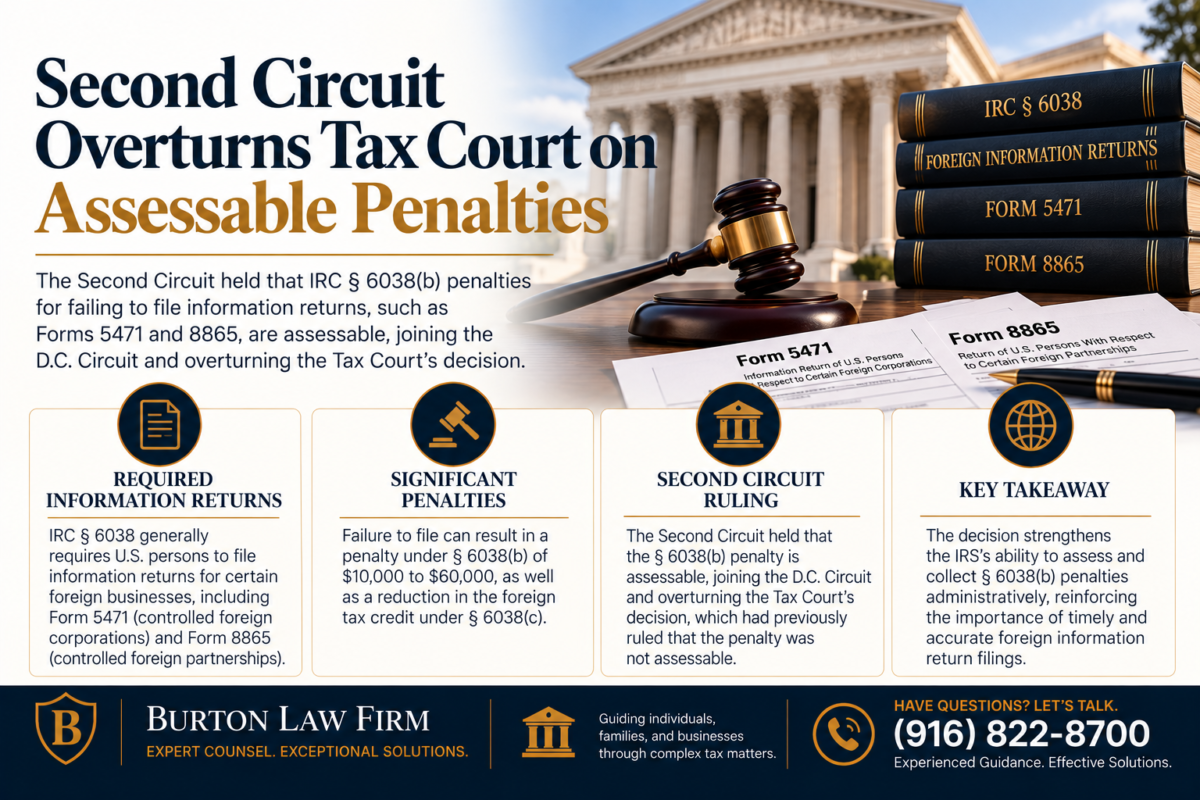
Section 6038 generally requires a U.S. person to file an information return regarding each foreign business the U.S. person controls. For example, Form 5471 is for controlled foreign corporations, and Form 8865 is for controlled foreign partnerships. Failing to file incurs two penalties. One (§ 6038(b)) charges a minimum of $10,000 and a maximum of $60,000 if not cured.[1] The other (§ 6038(c)) reduces the foreign tax credit by a minimum of 10% and a maximum of 100% if not cured, but this is reduced by the amount of the other penalty.[2]
Normally, a creditor must sue in a court of law to collect a debt. There is an exception for one of the most common debts, the income tax. Then, “[o]nly in rare instances is a lawsuit necessary. The agency can instead usually collect taxpayers’ liabilities through ‘assessment.’”[3] An assessment “allow[s] the IRS to seize assets, freeze bank accounts, and create liens—all without setting foot in a courtroom.”[4] This can be contested, but only on the taxpayer’s initiative. A private creditor sues to collect a debt, and a taxpayer sues for a tax not to be collected.
Safdieh v. Commissioner
In Safdieh v. Commissioner, the taxpayer failed to file under § 6038 for the 2005-2009 tax years. The penalties totaled $50,000. The question is whether this can be assessed. This was first answered by the Tax Court in 2023 through Farhy v. Commissioner.[5] There, the Tax Court ruled that § 6038(b) is not an assessable penalty. However, the D.C. Circuit reversed the Tax Court, holding that § 6038(b) is an assessable penalty.[6] This did not settle the matter outside of the D.C. Circuit. Another § 6038(b) case arose, and the Tax Court clarified in Mukhi v. Commissioner that it will follow its original Farhy reasoning outside of the D.C. Circuit.[7] The Tax Court repeated this policy in subsequent decisions, including Safdieh v. Commissioner.[8] The 2nd Circuit joined the D.C. Circuit in overruling the Tax Court in this matter.
Section 6038(b) does not explain whether the penalty is assessable. “Despite the parties’ attempts at exegesis, the text simply does not say whether the penalty is, or is not, assessable.”[9] Nevertheless, the 2nd Circuit found three reasons why the penalty is assessable. The first is through legislative history, the second is the statutory purpose, and the third is the placement of statutory language in the United States Code.
The penalty in question was enacted in 1982. The accompanying Senate report explained that the existing penalty (regarding the foreign tax credit) is insufficient for multiple reasons, including its complexity. To the 2nd Circuit, this makes the decision to make the new penalty nonassessable “implausible”: “It is unlikely that Congress would have wished to put even more logs in the way of the tax harvester when its stated aim was to clear the road.”[10] Specifically, “[t]he Committee Print indicates that the fixed dollar penalty was meant to ‘simplify the penalty for failure to furnish information’ by ‘giv[ing] Internal Revenue Service agents a simple straight-forward penalty to impose where reports . . . are not filed or are inadequate.’”[11] Requiring the IRS to go to the Justice Department to go to a district court would not accomplish that mission of simplicity. The IRS has assessed the penalty since its enactment. “As evidence of the statute’s original meaning, it deserves substantial weight.”[12] This is distinct from deferring to the IRS, the 2nd Circuit argued. Furthermore, Congress knowingly acquiesced in this practice of assessment. The Federal Courts Improvement Act was also enacted in the same year as the penalty for the purpose of decreasing the caseload of the district courts. It would be illogical for the same Congress to increase the caseload. Furthermore, the threshold for diversity jurisdiction was ten times the original § 6038(b) penalty amount. “Saddling the Commissioner with a federal case over such a small sum would hamper the federal courts and the Commissioner at a time when the evidence suggests that Congress wished to relieve both.”[13]
Section 6038(c)(3) coordinates the two § 6038 penalties by providing that the § 6038(c) penalty regarding the foreign tax credit is decreased by the amount of the § 6038(b) penalty. To the 2nd Circuit, this was ample proof that the two penalties were intended to be assessed in tandem. Diverging the two penalties would result in gross inefficiency. “We give Congress more credit than that.”[14] Due to this dissonance “parties may try to game the proceedings by rushing to judgment in the ‘right’ court and erecting barriers to judgment in the ‘wrong’ one.”[15]
The taxpayer claimed that 28 U.S.C. § 2461(a) is the Commissioner’s sole authority to collect the penalty. This is not in the Internal Revenue Code, which was determinative for the 2nd Circuit. “Even more revealingly, in the thirty-four years between this provision’s enactment in 1948 and the dollar penalty’s enactment in 1982, the provision was never used to collect a tax or tax penalty.”[16]
Farhy & Mukhi
The Tax Court’s theory, as articulated in Farhy v. Commissioner and Mukhi v. Commissioner, was left entirely unmentioned. Consequently, it is unlikely that the Tax Court will change its mind after Safdieh when it declined to do so in Mukhi v. Commissioner after the D.C. Circuit Court overturned the Tax Court in Farhy v. Commissioner.
The Tax Court premised its analysis in both Farhy and Mukhion on a Supreme Court quote, “[a]gencies have only those powers given to them by Congress.”[17] This was unmentioned by the 2nd Circuit Court. To the Tax Court, the IRC simply did not designate the penalties as “assessable” and therefore they were not assessable. It refused to “infer[] the power to administratively assess and collect the section 6038(b) penalties when Congress did not see fit to grant that power to the Secretary of the Treasury expressly as it did for other penalties in the Code.”[18] Even if the legislative history indicated otherwise, it cannot overcome the plain (lack of) language in the statute. “The text is clear, and therefore we need not consider legislative history to attempt to ascertain Congress’s intentions.”[19] In any case, the Tax Court was unimpressed with the passage that so moved the circuit courts. “We will not read a passing statement about the complicated nature of a penalty as empowering the IRS to assess a different penalty.”[20]
Ultimately, the Tax Court considers appellate decisions by courts other than the Supreme Court as essentially optional to follow. “The Tax Court adheres to the doctrine of stare decisis” and “takes seriously its obligation to facilitate uniformity in the tax law” as a nationwide court.[21] “When one of our decisions is reversed by an appellate court, the Court will thoroughly reconsider the problem in the light of the reasoning of the reversing appellate court and, if convinced thereby, follow the higher court.”[22] Yet if “convinced that our original decision was right, the proper course is to follow our own honest beliefs until the Supreme Court decides the point.”[23] Nevertheless it will follow a contrary appellate decision when both the decision is “squarely on point” and an appeal from the Tax Court would rest in the circuit court that issued the contrary decision.[24] “To do otherwise would be futile and wasteful given the inevitable reversal from the appellate court.”[25]
If you were assessed with a penalty for failing to file Form 5471, Form 8865, or another IRS form, please call 916-822-8700 or email info@lawburton.com.
[1] IRC § 6038(b). The minimum penalty is $10,000, with another $10,000 charged for each 30-day period (up to $50,000) after 90 days from the day the IRS mails notice of the failure to file to the taxpayer.
[2] § 6038(c). Similar to the other penalty, the foreign tax credit reduction starts at 10% and is further reduced by 5% for each additional 3-month period that the taxpayer does not file after 90 days from the day that notice of the failure to file is mailed by the IRS to the taxpayer.
[3] Safdieh v. Comm’r, 2026 U.S. App. LEXIS 5796, *3.
[4] Id. at *4.
[5] 160 T.C. 399 (2023), rev’d and remanded, 100 F.4th 223 (D.C. Cir. 2024).
[6] Farhy v. Comm’r of IRS, 100 F.4th 223 (2024).
[7] 163 T.C. 150 (2024).
[8] Safdieh v. Commissioner, No. 11680-20L, 2024 U.S. Tax Ct. LEXIS 3021 (T.C. Dec. 5, 2024); Cauchon v. Commissioner, No. 23863-22L, 2025 U.S. Tax Ct. LEXIS 405 (T.C. Feb. 14, 2025).
[9] Safdieh v. Comm’r, 2026 U.S. App. LEXIS 5796, *5 fn.18.
[10] Id. at *7.
[11] Id. at *7 fn.29.
[12] Id. at *7.
[13] Id. at *9.
[14] Id. at *11.
[15] Id. at *12.
[16] Id. at *13.
[17] Farhy v. Commissioner, 160 T.C. 399, 404 (2023)(quoting West Virginia v. EPA, 597 U.S. 697, 723 (2022)); Mukhi v. Commissioner, 163 T.C. 150, 156 (2024)(quoting West Virginia v. EPA, 597 U.S. 697, 723 (2022)).
[18] Farhy v. Commissioner, 160 T.C. 399, 406 (2023).
[19] Mukhi v. Commissioner, 163 T.C. 150, 160 (2024).
[20] Id. at 165..
[21] Id. at 154 (2024).
[22] Id.(omitting internal quotation mark and ellipsis).
[23] Id.(omitting internal quotation mark and brackets).
[24] Id.(omitting internal brackets).
[25] Id.(omitting internal quotation marks).