
Introduction
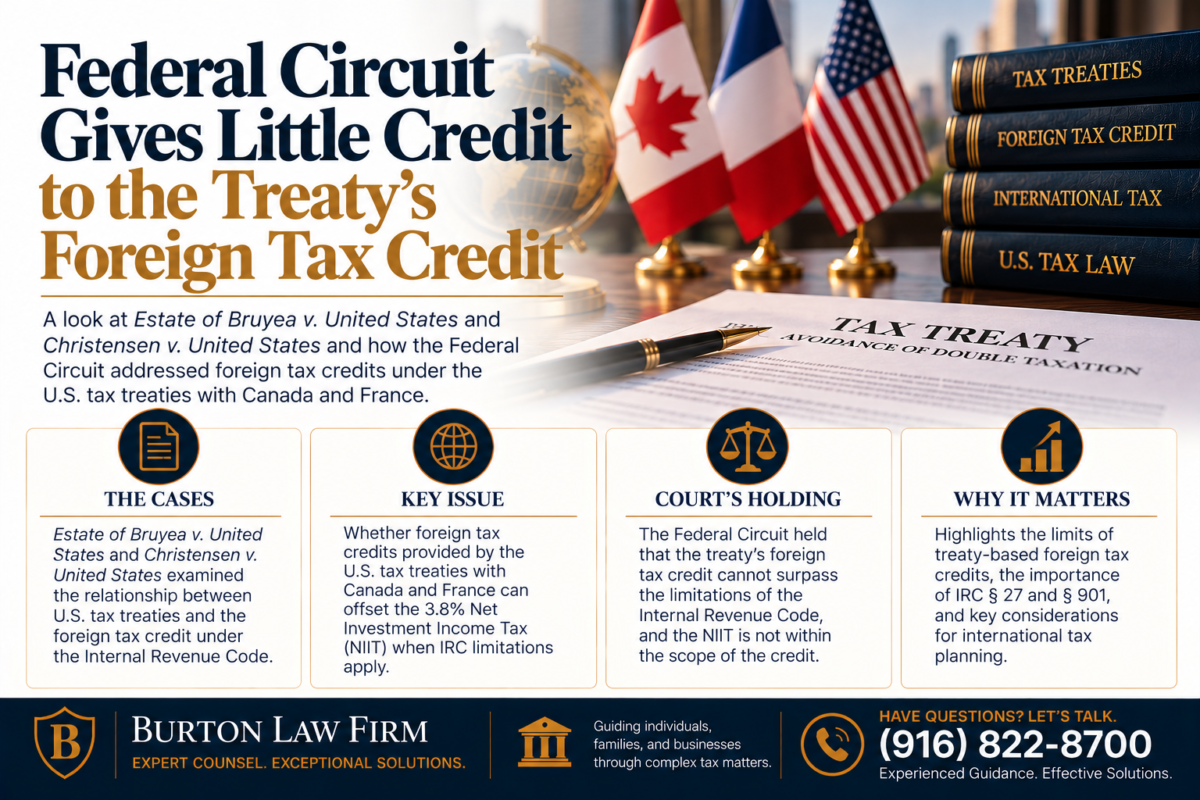
U.S. citizens are generally taxed on worldwide income. To alleviate double taxation, the Internal Revenue Code (IRC) offers a credit for foreign taxes paid. Tax treaties with the U.S. usually provide for a foreign tax credit as well. Estate of Bruyea v. United States and Christensen v. United States discuss the relationship between these two credits in the context of the Canadian tax treaty and the French tax treaty. Both cases were decided by the same panel of the Federal Circuit and were written by Judge Leonard Stark. Ultimately, the foreign tax credit offered by that treaty cannot surpass the limitations imposed by the Internal Revenue Code, according to the Federal Circuit. One limit is the exemption of the Net Investment Income Tax (NIIT) of 3.8% from the foreign tax credit’s scope. Section 27 of the IRC states in full and without a period at the end: “The amount of taxes imposed by foreign countries and possessions of the United States shall be allowed as a credit against the tax imposed by this chapter to the extent provided in section 901”.[1] In turn, section 901 also applies the FTC to “the tax imposed by this chapter.” Both sections are in Chapter 1, but the NIIT is in Chapter 2A.[2]
The Health Care and Education Reconciliation Act of 2010 created the NIIT decades after the French and Canadian treaties were written.[3] According to the Government Publishing Office, that legislation is 55 pages. The congressional report is divided into two volumes.[4] The first is 902 pages, and the second is 445 pages long. Neither mentions the NIIT.
The Disputed Language
The pertinent treaty language is:[5]
In the case of the United States, subject to the provisions of paragraphs 4, 5 and 6, double taxation shall be avoided as follows: In accordance with the provisions and subject to the limitations of the law of the United States (as it may be amended from time to time without changing the general principle hereof), the United States shall allow to a citizen or resident of the United States… as a credit against the United States tax on income the appropriate amount of income tax paid or accrued to Canada…
Where a United States citizen is a resident of Canada, the following rules shall apply… For the purposes of computing the United States tax, the United States shall allow as a credit against United States tax the income tax paid or accrued to Canada after the deduction referred to in subparagraph (a). The credit so allowed shall not reduce that portion of the United States tax that is deductible from Canadian tax in accordance with subparagraph (a).
This was parsed by the Federal Circuit through five clauses it numbered:[6]
[1] the “Avoidance Clause” (“subject to the provisions of paragraphs 4, 5, and 6, double taxation shall be avoided”);
[2] the “U.S. Law Limitation” (“In accordance with the provisions and subject to the limitations of the law of the United States (as it may be amended from time to time . . .)”);
[3] the “General Principle Clause,” which modifies the U.S. Law Limitation by providing that any post-Convention amendments to U.S. tax laws will not “chang[e] the general principle hereof;”
[4] the “paragraph 1 Credit Clause” (“the United States shall allow to a citizen . . . of the United States . . . as a credit against the United States tax on income the appropriate amount of income tax paid or accrued to Canada”); and
[5] a similar “paragraph 4(b) Credit Clause,” specifically available to “a United States citizen [who] is a resident of Canada” (“the United States shall allow as a credit against United States tax the income tax paid or accrued to Canada”).
Thus, the purpose is double taxation avoidance. There are two clauses allowing for a credit based on the tax paid to Canada. The first is paired with language subordinating it to U.S. law. This limitation is itself restricted. The “general principle” of the treaty remains unchanged. The second credit clause is three paragraphs away in the context of a U.S. citizen residing in Canada. Such a person is entitled to a credit after the application of Canada’s own version of the foreign tax credit, a deduction. However, the U.S. credit cannot reduce the tax for which the Canadian deduction applied.
Bruyea Analysis
The credit applies to the “United States tax,” which is broadly defined as the court explained in Bruyea: “Article II adds that the treaty ‘appl[ies] to taxes on income . . . imposed on behalf of [Canada and the United States], irrespective of the manner in which they are levied,’ including to “the Federal income taxes imposed by the Internal Revenue Code’ and ‘[a]ny taxes identical or substantially similar to those taxes’ that are added to the Code in the future.”[7] However, “just because the § 1411 [NIIT] is a ‘covered’ tax under Article II(3) of the Treaty does not mean that Article XXIV(1) authorizes a credit to offset that tax.”[8] This “is the start of the analysis, not its conclusion.”[9]
Despite being an “interpretive puzzle,” the Federal Court held that the solution is straightforward because the treaty version of the foreign tax credit is explicitly subject to the IRC.[10] The happenstance that the exclusion is due solely to the inclusion of NIIT in chapter 2A instead of chapter 1 is irrelevant. “[W]e conclude that the placement of the NIIT in chapter 2A, in view of Congress’ presumed knowledge that the Code only authorizes foreign tax credits to apply against chapter 1 taxes, constitutes an intentional decision to exclude the NIIT from the offset regime.”[11] The Court of Federal Claims held that this changed the “general principle.” In contrast, the Federal Circuit argued that “[t]here is no indication, in the Convention or elsewhere, that the creation of a single new type of income tax, and Congress’ determination not to make that tax eligible for a foreign tax credit, violates the General Principle Clause and its broad goal of reducing double taxation.”[12] The taxpayer “fails to persuade us that the adoption of the NIIT, subsequent to execution of the Convention, combined with the NIIT’s ineligibility under the Code for offset by a foreign tax credit, runs afoul of this general principle. The Convention does not entirely ‘eliminate’ double taxation; as the Avoidance Clause states, its ambition is only that ‘double taxation shall be avoided.’”[13] The court quoted the treaty provision that the two countries “may also consult together for the elimination of double taxation in cases not provided for in the Convention,” to suggest that the elimination of double taxation was not truly the treaty’s intention.[14] The title of the relevant treaty article is “Elimination of Double Taxation.” The Federal Circuit further suggested that even if the NIIT violated the treaty, the remedy is such “sovereign-to-sovereign relief.”[15] There is not any indication within the treaty that this is the exclusive remedy.
Perhaps the primary rationale for the Court of Federal Claims’ holding that the treaty version of the credit applies to the NIIT is that its subordination to the IRC would make the treaty credit superfluous. What is the point of the treaty credit if it is the same as the IRC credit? The Federal Circuit had an answer. “[G]enerally, a U.S. citizen cannot take a foreign tax credit on U.S.-source income.”[16] However, the treaty created an exception to this rule not found in the IRC. The Federal Circuit cited this phenomenon as proof that the treaty foreign tax credit is not independent. If it were, the court argued, this would be “superfluous.”[17] The court also pointed to the explicit inclusion of the accumulated earnings tax and the personal holding company tax (each otherwise excluded from the foreign tax credit’s scope) as “show[ing] that when the treaty drafters intended for the Convention to alter the Code’s default treatment of a category of credit-excepted taxes (like the NIIT), they said so explicitly.”[18]
The Federal Circuit further argued that adopting the taxpayer’s interpretation “would yield anomalous results” which “are to be avoided if at all possible.”[19] As discussed, there are two credit clauses. The general credit clause is paired with the U.S. Law Limitation clause, but the credit clause specific to U.S. citizens residing in Canada is not explicitly connected with the U.S. Law Limitation clause. To the court, the taxpayer’s interpretation would favor U.S. citizens residing in Canada. “We have no basis to conclude that the parties to the Convention intended these anomalous results of treating U.S. citizens living in Canada better than their similarly-situated counterparts living in the U.S.”[20] Nevertheless, the credit clause applicable only to U.S. citizens living in Canada remains. If it does not provide different treatment (which presumably can only be favorable), it is unclear what the purpose or function of this clause is. The court did not provide any suggestions.
Extrinsic Evidence
The trial court and the taxpayer argued that the U.S. Law Limitation is “restricted to computation-related ‘provisions’ and ‘limitations’ of the Code.”[21] This derives from extrinsic evidence, such as the treaty’s technical explanation contemporaneously written by the Treasury Department. The Federal Circuit doubted this evidence, but disclaimed that regardless of its strength, “it cannot alter our interpretation of the unambiguous provisions of the Convention.”[22] Implicitly, it would appear that the question of when the “general principle” is “chang[ed]” has an answer that is unambiguous to the Federal Circuit. However, the court did not reveal that answer.
In contrast, the Court of Federal Claims found the extrinsic evidence to be quite relevant and persuasive. The technical explanation states (with emphasis added by the court): “Paragraph 1 provides a credit for these specified taxes whether or not they qualify as creditable under Code section 901 or 903.”[23] This “alone is a complete refutation of the government’s overall position.”[24] The technical explanation also referred to a “taxpayer who claims credit under the Convention for Canadian taxes made creditable solely by paragraph 1.”[25] The trial court further credited the treaty’s transmittal letter and the Joint Committee on Taxation’s (JCT) explanation for the intent to eliminate double taxation. “And here’s another total refutation of the government’s position from the JCT Explanation: ‘[T]he treaty’s rules are used only if the taxes are not creditable under the Code.’”[26] The government’s attempt to rely on the separate technical explanation for the 2006 U.S. model treaty (twenty-six years later) backfired because it stated that “the United States will allow a credit to its citizens and residents in accordance with the Article, even if such credit were to provide a benefit not available under the [I.R.C.].”[27] The taxpayer in Bruyea also successfully enlisted Canada’s support, according to the court.[28] All of this was disregarded by the Federal Circuit.
Christensen Analysis
The trial court in Bruyea claimed that the U.S. Law Limitation clause applied to the second credit clause, the one specific to U.S. citizens residing in Canada. The Federal Circuit agreed but provided its rationale in Bruyea’s companion case, Christensen v. United States, published on the same day as Bruyea. Although Christensen regarded the French tax treaty, “the treaty provisions relevant to the dispute in Bruyea are materially identical to those at issue here.”[29] In Christensen, the Court of Federal Claims ruled in favor of the taxpayer because the U.S. Law Limitation clause did not appear with the second credit clause. Yet, that was irrelevant, according to the Federal Circuit. “It is commonplace to speak — and, more to the point, for Congress to draft — in economies that eliminate such redundancy.”[30] This is reflected in the “distributive canon” of statutory interpretation, which “recognizes that sometimes where a sentence contains several antecedents and several consequents, courts should read them distributively and apply the words to the subjects which, by context, they seem most properly to relate.”[31] Paragraphs of the same section must be read together. Once they “are read together, it is clear the introductory U.S. Law Limitation carries over,” functioning “as an overarching qualifier,” according to the Federal Circuit.[32] The remainder of Christensen’s opinion was essentially a copy of Bruyea’s opinion.
Conclusion
“Simply put, we cannot read an amendment into the Convention.”[33] Instead, “[i]n our view, the government correctly reads the U.S. Law Limitation, and therefore the Code, as governing in all instances except when the Convention expressly states that it does not.”[34]As often repeated in cases denying taxpayers an exemption or a deduction, “[w]hether and to what extent deductions shall be allowed depends upon legislative grace; and only as there is clear provision therefor can any particular deduction be allowed.”[35] Thus, such tax provisions are construed against the taxpayer. However, the 6th Circuit reflected in 1945: “Relief from double taxation is not so much an act of grace as one of justice in determining the true net income of the taxpayer.”[36] As Bruyea itself asserted, “[i]n construing a treaty, the terms thereof are given their ordinary meaning in the context of the treaty and are interpreted, in accordance with that meaning, in the way that best fulfills the purposes of the treaty.”[37] As of writing, it is unclear whether the taxpayers will appeal these decisions, whether to the Supreme Court or as a petition to the Federal Circuit for a rehearing en banc by the full court and not just a panel. For now, taxpayers may rely only on explicit tax treaty positions to the extent they are contrary to the IRC. Although each tax treaty is different, most are based on a model tax treaty, as is the case with the Canadian and French tax treaties.
If you have any foreign tax credit questions, please call 916-822-8700 or email info@lawburton.com.
[1] IRC § 27.
[2] IRC § 1411.
[3] Public Law 111-152.
[4] H. Rept. 111-443.
[5] U.S.—Canada Tax Treaty, Art. XXIV(1) & (4).
[6] Est. of Bruyea v. United States, No. 2025-1563, 2026 U.S. App. LEXIS 26543, at *9 (Fed. Cir. Aug. 31, 2026).
[7] Id. at *23-24(brackets and ellipsis added by the court).
[8] Id. at *25.
[9] Id. at *24.
[10] Id. at *13.
[11] Id. at *14.
[12] Id. at *26.
[13] Id. at *25(emphasis added by the court).
[14] Id.
[15] Id. at *26 n.6. As support, the Federal Circuit cited the treaty provision “setting out, in Article XXVI, ‘Mutual Agreement Procedure,’ including how taxpayer should proceed when he “considers that the actions of one or both of the Contracting States result or will result for him in taxation not in accordance with the provisions of this Convention.” Yet the court interrupted the quoted provision, which continued “he may, irrespective of the remedies provided by the domestic law of those States, present his case in writing to the competent authority of the Contracting State of which he is a resident or, if he is a resident of neither Contracting State, or which he is a national.” U.S.—Canada Tax Treaty, Art. XXVI(1).
[16] Est. of Bruyea v. United States, No. 2025-1563, 2026 U.S. App. LEXIS 26543, at *19 (Fed. Cir. Aug. 31, 2026).
[17] Id. at *20.
[18] Id. at *18.
[19] Id. at *20(omitting internal quotation marks).
[20] Id. at *22.
[21] Id. at *27.
[22] Id. at *29.
[23] Bruyea v. United States, 174 Fed. Cl. 238, 257 (2024)(emphasis added by the court).
[24] Id.
[25] Id.(emphasis added by the court).
[26] Id.(emphasis and brackets added by the court).
[27] Id. at 258(emphasis and brackets added by the court).
[28] “The position of the Canadian competent authority in this regard is that Canada, as the country of source, has the right to tax the gain, while the US, as the country which has residual taxation rights, must provide relief in accordance with Article XXIV of the Convention.” Id.
[29] Christensen v. United States, No. 2024-1284, 2026 U.S. App. LEXIS 26539, at *8 (Fed. Cir. Aug. 31, 2026).
[30] Id. at *10-11.
[31] Id. at *11.
[32] Id. at *12.
[33] Est. of Bruyea v. United States, No. 2025-1563, 2026 U.S. App. LEXIS 26543, at *18 (Fed. Cir. Aug. 31, 2026).
[34] Id. at *20 n.5(emphasis in original).
[35] Id. at *15(quoting New Colonial Ice Co. v. Helvering, 292 U.S. 435, 440 (1934)).
[36] Gentsch v. Goodyear Tire & Rubber Co., 151 F.2d 997, 1000 (6th Cir. 1945).
[37] Est. of Bruyea v. United States, No. 2025-1563, 2026 U.S. App. LEXIS 26543, at *11 (Fed. Cir. Aug. 31, 2026)(quoting Xerox Corp. v. United States, 41 F.3d 647, 652 (Fed. Cir. 1994)).