
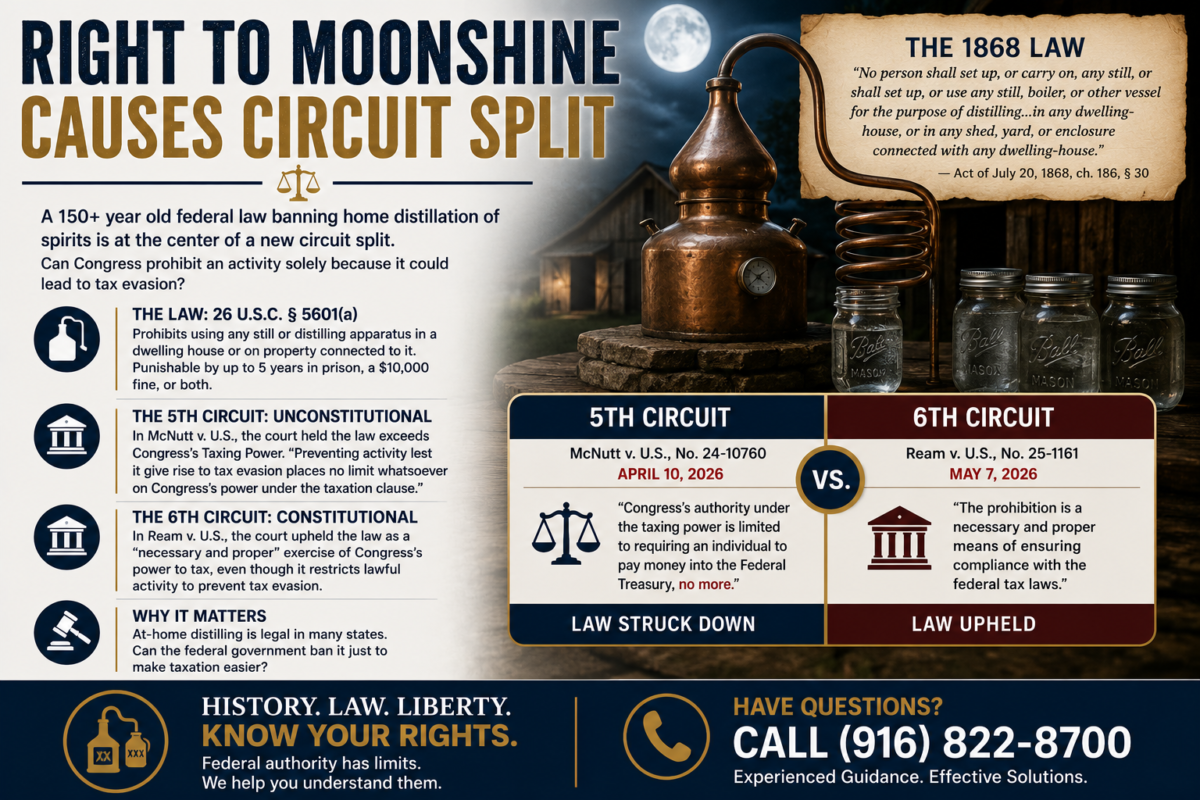
In 1868, Congress passed a law taxing tobacco and distilled spirits. The same statute “prevented a person from using ‘any still, boiler, or other vessel for purpose of distilling’ when the still was located, among other places, ‘in any dwelling-house’ or ‘in any shed, yard, or enclosure connected with any dwelling-house.’”[1] Doing so is a crime punishable by imprisonment for up to 5 years or a fine of up to $10,000, or both.[2] In April 2026, the 5th Circuit Court struck down this restriction as unconstitutional in McNutt v. U.S.,yet the 6th Circuit upheld the same law in Ream v. U.S soon thereafter.
“The government defends the statutory prohibition on at-home distillation of spirits as a ‘necessary and proper’ exercise of Congress’s power to ‘tax.’”[3] Specifically, prohibiting at-home distillation would promote the tax since it would be relatively easy to evade the tax if the distillation occurred at home. The 5th Circuit disagreed. “[P]reventing activity lest it give rise to tax evasion places no limit whatsoever on Congress’s power under the taxation clause.”[4] Quoting the Supreme Court, “Congress’s authority under the taxing power is limited to requiring an individual to pay money into the Federal Treasury, no more.”[5] Here, the challenged law prevents revenue by preventing the revenue-generating activity. The 6th Circuit agreed that the Taxing Clause is limited to taxing in a much briefer analysis.
For reasons unknown, the government abandoned its Commerce Clause on appeal in McNutt v. U.S. and apparently did not cite it as justification in Ream v. U.S.[6] Therefore, neither the 5th nor the 6th Circuit considered the Commerce Clause for this issue. The District Court for McNutt rejected the government’s Commerce Clause claim because “where regulating a purely local activity does not serve a broader, overarching statutory scheme, Congress cannot not [sic] reach it.”[7] The wheat restriction upheld in Wickard v. Filburn was part of an elaborate statutory scheme.[8] However, the prohibition litigated here “is not a ‘comprehensive’ regulation of commerce of the kind that allows Congressional intervention in every related local activity. This is because the Act does not directly regulate the supply and demand of alcohol, does not make Congress a production manager over each distillery to inflate prices, and is not part of a federal directive to either promote or eliminate a national marketplace for alcohol.”[9] The relative nakedness of the home distillery ban distinguishes it from the federal ban on controlled substances.
Instead of the Commerce Clause, both Ream and McNutt turned on the Necessary and Proper Clause, the “last, best hope of those who defend ultra vires congressional action.”[10] “In general,” this “gives Congress power to pass laws both ‘vertically’ to implement its own enumerated powers and ‘horizontally’ to implement the constitutionally vested powers of federal executive and judicial officers.”[11] The primary standard dates from 1819 in McCulloch v. Maryland: “Let the end be legitimate, let it be within the scope of the constitution, and all means which are appropriate, which are plainly adapted to that end, which are not prohibited, but consist with the letter and spirit of the constitution, are constitutional.”[12] Nevertheless, “even where a law is necessary, it may still be improper.”[13] “[T]o be necessary, a law must be plainly adapted to an enumerated power.”[14] Here, the law prevents the activity from being taxed rather than assisting in the taxation of the activity. This is similar to a law struck down as unconstitutional in U.S. v. Dewitt, a 1869 Supreme Court case. “There, the challenged statute prohibited the sale of naphtha mixed with illuminating oils. The government attempted unsuccessfully to defend the statute’s constitutionality under the Commerce Clause and taxing power.”[15] The Supreme Court found that it was too attenuated from the taxation to be considered “necessary.”
A law is “proper” under the Necessary and Proper Clause “when it is not prohibited by another enumerated powers [sic] and is consistent with the letter and spirit of the constitution.”[16] Such consistency is absent here, according to the 5th Circuit. Ruling otherwise risks “creating a general federal authority akin to the police power.”[17] Ultimately, the law’s legal defense was a non-sequitur. “Logically, the Necessary and Proper Clause cannot expand the reach of the taxing power to criminalize conduct that could produce taxable revenue under the pretext that generating revenue for the federal government will be enhanced.”[18] Nevertheless, the injunction is limited to the plaintiffs.
The 6th Circuit created a circuit split through Ream v. U.S. The majority of the panel upheld the law as constitutional, while one judge dissented, arguing that the plaintiff lacked standing. The dissenting opinion cited the 5th Circuit’s McNutt v. U.S. to contrast the standing in that case with Ream. However, the majority did not mention McNutt. Ream had a different perspective on the challenged law’s logic. “Even now its rationale is almost self-evident: stills are more easily hidden in homes than in bonded premises dedicated to distilling spirits.”[19] Ream also countered the argument that the law reduces revenue rather than increases it. “As a matter of direct causation, that might be so; but Congress can take account of causal chains longer than that.”[20] Specifically, “Congress had ample reason to conclude that, for every at-home distiller who pays the tax, many others would not. The ban thus shifts consumption from untaxed spirits to taxed spirits—thereby increasing revenue.”[21] Consequently, the law is “necessary” under the Necessary and Proper Clause. As for propriety and concerns of general police power implications, the Necessary and Proper Clause’s application cannot be abstracted and reused with ease. “[W]hether a law is ‘plainly adapted’ to a permissible end depends on an empirical judgment—which is to say the judgment is, by nature, factbound.”[22] There were more than enough pertinent facts here, the court held. “Here, those facts include a history of tax evasion as old as the Republic itself; and Congress concluded—based on that history, and after a month of testimony before a select committee of the House—that the home-distilling ban, along with the 1868 Act’s other provisions, were in fact necessary to collect federal excise taxes on spirits.”[23] Collecting excise taxes on alcohol is a distinctive challenge, permitting flexibility. “Indeed, rules concerning alcohol more generally are unique as to the evasion that often accompanies them—from excise taxes, to Prohibition, to the use of fake IDs to obtain alcohol (itself almost a rite of passage for some generations), to moonshiners even today. The judgment required in this case, again, is an empirical one; and empirically, alcohol is sui generis, or very close to it.”[24]
It remains to be seen whether Ream or McNutt will prevail. Perhaps neither will, and the country will be split between “wet” and “dry” states regarding home distilleries. Indeed, this is the statistically likely outcome given the scarcity of Supreme Court decisions. Defenders of the Ream ruling will need to address U.S. v. Dewitt because Ream did not. Dewitt seems strikingly similar to the facts at hand. Although the 1869 case seemed most concerned with the federal regulation of intrastate commerce, a subject that has since become more nuanced, it also ruled that the Necessary and Proper Clause was insufficient. However, Dewitt does not necessarily support McNutt as McNutt claimed. In Dewitt, the prohibition was on a specific type of oil that is not taxed, supposedly to promote other types of oil that are taxed. Dewitt explicitly distinguished it from the statutory framework for liquor taxation:
And we have been referred to provisions, supposed to be analogous, regulating the business of distilling liquors, and the mode of packing various manufactured articles; but the analogy appears to fail at the essential point, for the regulations referred to are restricted to the very articles which are the subject of taxation, and are plainly adapted to secure the collection of the tax imposed; while, in the case before us, no tax is imposed on the oils the sale of which is prohibited.[25]McNutt nevertheless relied on this discussion to hold that an important restriction on the business of distilling liquors is unconstitutional.
[1] McNutt v. United States DOJ, No. 24-10760, 2026 U.S. App. LEXIS 10423, at *5 (5th Cir. Apr. 10, 2026).
[2] The district court in McNutt noted: “As a matter of principle, this Court is distressed at an impropriety contained in TTB’s letter. Regardless of the reader’s level of comfort with the federal government receiving purchase data and using that data to ‘forewarn’ ne’er-do-well citizens about potential criminal liability, this Court is highly disturbed that the letter attempts to threaten a ‘$500,000 fine’ when the statutory maximum is $10,000. See 26 U.S.C. § 5601(a).” Hobby Distillers Ass’n v. Alcohol & Tobacco Tax & Trade Bureau, 740 F. Supp. 3d 509, 520 n.1 (N.D. Tex. 2024).
[3] McNutt v. United States DOJ, No. 24-10760, 2026 U.S. App. LEXIS 10423, at *12 (5th Cir. Apr. 10, 2026).
[4] Id. at *16-17.
[5] Id. at *14(quoting with emphasis added, Nat’l Fed’n of Indep. Bus. v. Sebelius, 567 U.S. 519, 574 (2012)).
[6] The plaintiff argued in the District Court that the Dormant Commerce Clause (a limitation on state law) somehow renders the law unconstitutional. Ream v. United States Dep’t of the Treasury, 771 F. Supp. 3d 998, 1007 (S.D. Ohio 2025).
[7] Hobby Distillers Ass’n v. Alcohol & Tobacco Tax & Trade Bureau, 740 F. Supp. 3d 509, 531 (N.D. Tex. 2024).
[8] Wickard v. Filburn, 317 U.S. 111 (1942).
[9] Hobby Distillers Ass’n v. Alcohol & Tobacco Tax & Trade Bureau, 740 F. Supp. 3d 509, 533 (N.D. Tex. 2024).
[10] McNutt v. United States DOJ, No. 24-10760, 2026 U.S. App. LEXIS 10423, at *17 (5th Cir. Apr. 10, 2026)(quoting Printz v. United States, 521 U.S. 898, 923, 117 S. Ct. 2365, 2378 (1997)).
[11] Id. at *17-18.
[12] Id. at *18(quoting McCulloch v. Maryland, 17 U.S. (4 Wheat.) 316, 421 (1819)).
[13] Id.(omitting internal quotation marks).
[14] Id.(omitting internal quotation marks).
[15] Id. at *22-23(omitting internal citation).
[16] Id. at *26(omitting internal brackets and quotation marks).
[17] Id. at *27 (5th Cir. Apr. 10, 2026)(quoting Nat’l Fed’n of Indep. Bus. v. Sebelius, 567 U.S. 519, 536 (2012)).
[18] Id.
[19] Ream v. U.S. Dep’t of the Treasury, No. 25-3259, 2026 U.S. App. LEXIS 11310, at *13 (6th Cir. Apr. 21, 2026).
[20] Id. at *15.
[21] Id.
[22] Id. at *17.
[23] Id.
[24] Id. at *17-18.
[25] United States v. Dewitt, 76 U.S. (9 Wall.) 41, 44 (1869).