
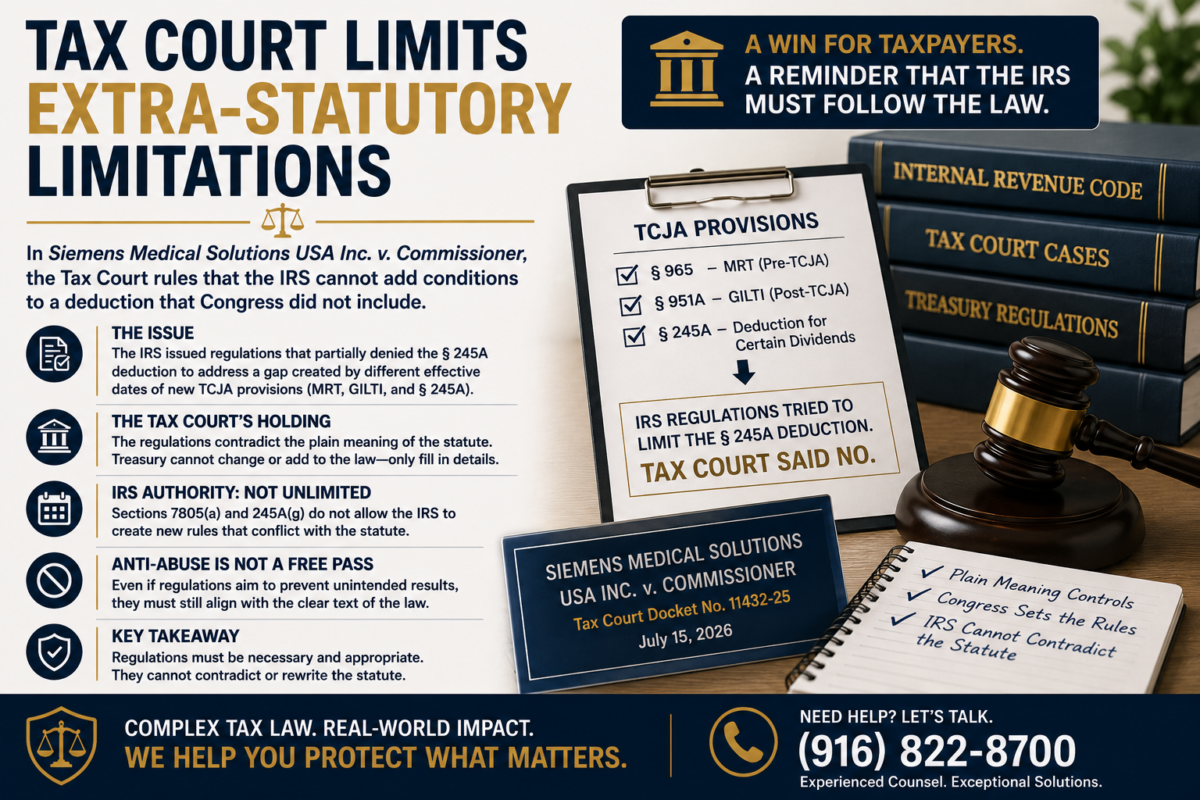
Simens Medical Solutions USA Inc. v. Commissioner is simultaneously broad and narrow in scope. The Tax Court’s judgment addresses a specific and unusual situation. However, its methodology in doing so is applicable to innumerable circumstances.
The Tax Cuts and Jobs Act of 2017 (TCJA) introduced many changes into the international aspects of the Internal Revenue Code. “[I]n general terms, section 965 (MRT) taxes foreign earnings accumulated before the TCJA was enacted while section 951A (GILTI) taxes post-TCJA foreign earnings. Section 245A allows a deduction for certain post-TCJA dividends from foreign corporations, effectively exempting such dividends from U.S. tax.”[1] However, “the section 245A deduction should apply only to the type of earnings that are not subject to subpart F, the GILTI, and the MRT.”[2] Each of these three new components (MRT, GILTI, and § 245A) has different effective dates. This leaves a gap whereby “the foreign income of a CFC may not be subject to any tax and yet still be eligible for the section 245A deduction.”[3] The IRS promulgated regulations to fill that gap by partially denying the § 245A deduction. Effectively, the regulations only regard the 2018 taxable year in rather specific scenarios. Yet, the question of whether the IRS could create such regulations affects nearly everyone.
In Simens Medical Solutions USA Inc., the taxpayer met all conditions set in § 245A for its deduction. That was enough for the Tax Court. In Varian Medical System v. Commissioner, the Tax Court rejected the IRS’s attempt to change the effective date of another section amended by the TCJA that was originally advantageous because it was mismatched with § 245A.[4] There, the IRS attempted to directly change the effective date rather than impose additional conditions. Here, the regulations “do not specifically change an effective date, but Treasury specifically drafted the Extraordinary Disposition Rules to address a gap created solely by different effective dates.”[5] At least in this instance, the IRS is barred by a congressional delegation version of the substance over form doctrine. “Thus, while the mechanism for addressing the perceived problem is different, the effect is materially the same.”[6]
The IRS claimed that sections 7805(a) and 245A(g) authorize the regulations in question. Section 7805(a) is the general delegation, providing that the IRS “shall prescribe all needful rules and regulations for the enforcement” of the Internal Revenue Code.[7] The more specific § 245A(g) provides that: “The Secretary shall prescribe such regulations or other guidance as may be necessary or appropriate to carry out the provisions of this section, including regulations for the treatment of United States shareholders owning stock of a specified 10 percent owned foreign corporation through a partnership.” The Tax Court explained that “appropriate is a quintessentially context dependent term that often draws its meaning from surrounding provisions.”[8] Yet “the statute contains no hint” of the regulations here.[9] “Treasury is not trying to construe the language of section 245A. Instead, Treasury is trying to correct the mismatch in effective dates by changing the plain meaning of the statute.”[10] The IRS may be able to “fill[] up the details of a statutory scheme.”[11] Nevertheless, “[a]dding entirely new rules at odds with the statute goes beyond filling in the gaps.”[12] The anti-abuse nature of these regulations is irrelevant. “[S]elf-serving regulations never justify departing from the statute’s clear text.”[13] Ultimately, “a regulation that purports to contradict the statute can be neither necessary nor appropriate.”[14]
The Treasury Regulations are filled with provisions not found in the Internal Revenue Code. The line between filling in the gaps left by the Code and rewriting it may be vague at times. However, if the regulations’ substance is not even “hinted” at by the statutes, they may exceed the IRS’s authority.
[1] Siemens Med. Sols. USA, Inc. v. Commissioner, No. 11432-25, 2026 U.S. Tax Ct. LEXIS 1531, at *10 (T.C. July 15, 2026).
[2] Id. at *13.
[3] Id. at *14.
[4] Varian Med. Sys. v. Commissioner, 163 T.C. 76 (2024).
[5] Siemens Med. Sols. USA, Inc. v. Commissioner, No. 11432-25, 2026 U.S. Tax Ct. LEXIS 1531, at *20 (T.C. July 15, 2026).
[6] Id.
[7] Id. at *22.
[8] Id. at *23(omitting internal quotation marks and brackets).
[9] Id. at *24.
[10] Id.
[11] Id. at *26.
[12] Id.
[13] Id. at *25(omitting internal quotation marks).
[14] Id. at *24.