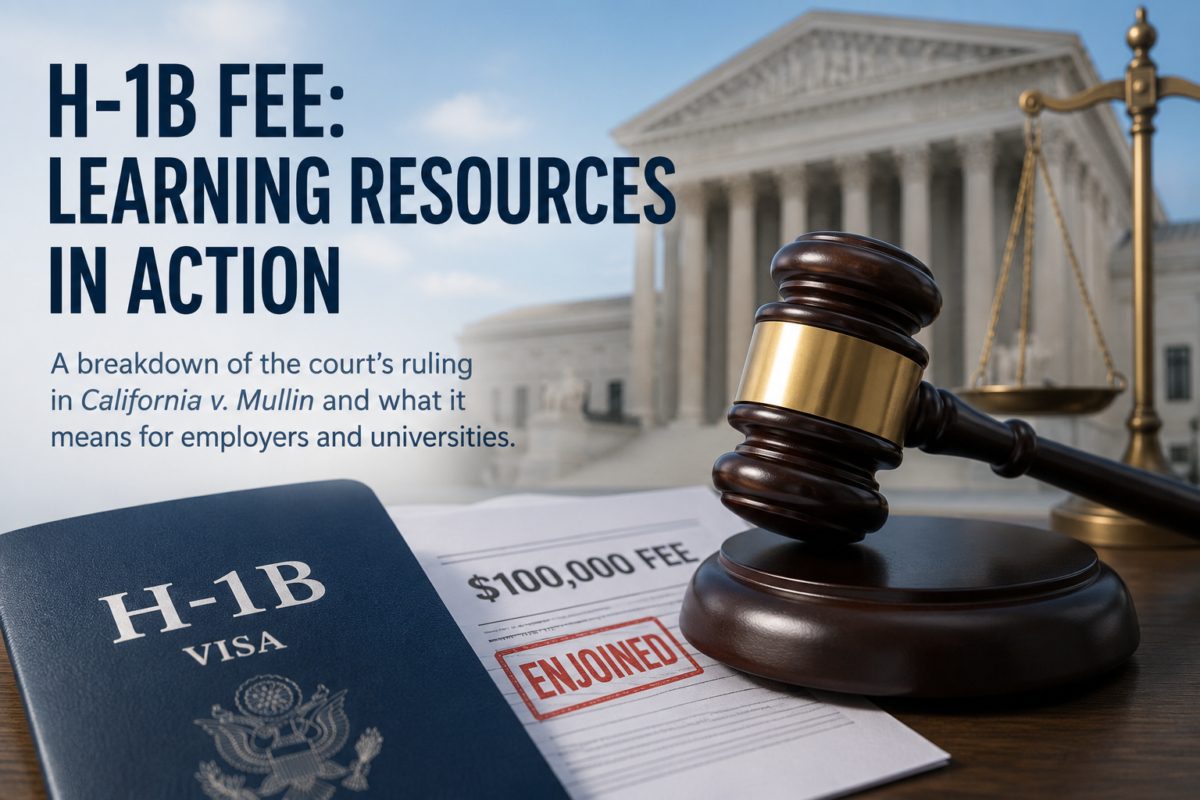
On September 19, 2025, President Trump imposed a $100,000 fee for H-1B visa applications. Twenty states filed suit in California v. Mullin,and the U.S. District Court, District of Massachusetts, ruled in their favor on June 8, 2026. The H-1B program was created in 1990 and “allows a U.S. employer to petition the government to hire a nonimmigrant worker in a specialty occupation for a maximum duration of six years.”[1] There is a general limit of 85,000 H-1B visas per year, but “the cap does not apply to (1) an institution of higher education or a related or affiliated nonprofit entity, or (2) a nonprofit research organization or governmental research organization,” which also enjoy other benefits such as the ability to bypass the H-1B lottery.[2]
The administration relied on three provisions of the Immigration and Nationality Act of 1952 (INA) for the fee increase. Section 212(f) of the INA provides that the President may “suspend the entry of all aliens or any class of aliens” as well as impose “any restrictions he may deem to be appropriate.”[3] Furthermore, Section 215(a) of the INA declares: “Unless otherwise ordered by the President, it shall be unlawful—for any alien to depart from or enter or attempt to depart from or enter the United States except under such reasonable rules, regulations, and orders, and subject to such limitations and exceptions as the President may prescribe.”[4] The President may also set fees “at a level that will ensure recovery of the full costs of providing all such services” regarding visas.[5] Nevertheless, it would appear that the government expended most of its energy in this case arguing against the possibility of judicial review for the fee increase.
Judicial Review
Generally, “the federal courts cannot review an executive officer’s denial of a visa,” according to a judicial rule known as “the doctrine of consular nonreviewability.”[6] Contrary to the federal government’s assertions, this is inapplicable here. “Here, Plaintiffs do not seek retrospective review of an executive officer’s decision to exclude a noncitizen but rather advance a forward-looking challenge regarding the lawfulness of the Policy carrying out the Proclamation.”[7]
“To act ultra vires a government official is either acting in a way that is impermissible under the Constitution or acting outside of the confines of his statutory authority.”[8] The Administrative Procedures Act (APA) is the primary vehicle for challenges to the federal government. Yet “even after the passage of the APA, some residuum of power remains with the district court to review agency action that is ultra vires.”[9] Yet to the administration, “[i]t is doubtful that ultra vires review is available to challenge presidential actions at all.”[10] The court conceded that it might lack the authority to enjoin the President, but it certainly can “enjoin the officers who attempt to enforce the President’s directive.”[11]
Judicial review of the President is either constitutional or statutory, and not “every action by the President, or by another executive official, in excess of his statutory authority is ipso facto in violation of the Constitution.”[12] Where the alleged violation is simply of the statute without any other constitutional concerns, any judicial review is statutory in nature. Sometimes, that characterization precludes judicial review. When a statute “commits decisionmaking to the discretion of the President, judicial review of the President’s decision is not available.”[13] Here, however, “Plaintiffs do not simply claim that the Executive Branch failed to comply with the terms of the INA. Their allegations implicate weighty constitutional concerns regarding the balance of power between the executive and legislative branches.”[14] The government’s repetitive assertions that the fee increase was authorized through Article II of the Constitution fortified the court’s conclusion. Nevertheless, an ultra vires review will not lie “if a statutory review scheme provides aggrieved persons with a meaningful and adequate opportunity for judicial review.”[15] The court suggested that would preclude ultra vires review here, due to the APA, but the government failed to raise that argument and therefore waived it.
APA jurisprudence is in a curious predicament. It applies to final agency actions, yet it does not apply to the President, according to the Supreme Court. “At what point does an agency’s implementation of a presidential directive amount to an exercise of the President’s power (which is unreviewable under the APA) rather than an exercise of agency action (which is subject to APA review)?”[16] The court did not cite any appellate cases to answer this question. However, there have been a string of district court cases relying on a law review article by Justice Kagan written nine years before she became a Supreme Court Justice wherein she reasoned that “[w]hen the challenge is to an action delegated to an agency head but directed by the President,” the President’s actions can be challenged as an agency’s actions.[17] This applied here, and the court found that there was final agency action for this matter.
Ruling on the Merits
The court moved on to the merits, beginning with whether the fee increase usurped the congressional taxing power. A monetary exaction is a penalty if it is a “punishment for an unlawful act or omission.”[18] There must be a negative legal consequence for the conduct incurring the payment beyond the actual payment. Otherwise, it is a tax for constitutional purposes. Here, “[h]iring workers pursuant to the H-1B program is plainly lawful,” and therefore the fee is a tax.[19] The government averred that the fee is not a tax because it was not collected by the IRS, and because the fee (somehow) does not increase total revenue. Both positions were wholly unsupported. Furthermore, the administration offered the “mere ipse dixit” that the fee is “a regulatory payment” and therefore “not the same as a tax.”[20] No authority was proffered for this proclamation, and the court found plenty against it. Claims that the President has the independent constitutional power to condition immigration on fees of any amount also appeared to discredit the government’s position.
The court easily ruled that the “restrictions” permitted by Section 212(f) do not encompass taxes, just as that term (and many synonyms) did not permit tariffs under the International Emergency Economic Powers Act, as Learning Resources determined. A statute delegating the power to tax must be explicit, which also disqualified Section 215(a)’s “limitations.” This was a straightforward application of Learning Resources. However, the court noted that “Defendants’ contrary interpretation regarding the scope of the President’s power under INA § 212(f) offers no perceivable limits. Their position that § 212(f) allows the President to impose any tax so long as it connects to a ‘restriction’ on the ‘entry of aliens’ deviates from the text of the statute. Congress authorized the President to ‘impose on the entry of aliens any restrictions he may deem to be appropriate’ when he finds that the entry ‘would be detrimental to the interests of the United States.’”[21] The court reserved its analysis of the statutory provision that does address fees for the APA portion of its opinion.
The court stressed that 8 U.S.C. § 1356(m)’s fees are limited to administrative cost recovery. Helpfully to the court, the government conceded that the disputed fees do not recover costs. Thus, the court found that the government acted in excess of its statutory authority, one of the grounds for setting aside a final agency action under the APA. The government similarly admitted that there was not any attempt to follow the notice-and-comment procedures. Yet it claimed that it was unnecessary because the executive order bypassed that requirement. Since the executive order was ultra vires, it did not have the force of law, the agency’s actions did. These required compliance with notice-and-comment procedures. The foreign-affairs exception to this requirement was inapplicable because the government did “not offered any evidence of the undesirable international consequences that would have flowed from complying with the APA’s procedural requirements. Nor have they explained any need for the immediate implementation of the $100,000 payment requirement.”[22] Similarly, the government did not articulate any emergency for the purposes of the good-cause exception. Any purported emergency would have been scrutinized by the court and applicable only when publishing that explanation alongside the rule. The government did not do so. APA jurisprudence focuses on whether there was adequate consideration of the costs and benefits in order for a rule to avoid the stigma of being arbitrary and capricious. Again, the government confessed that there was not any consideration, but it did not need to because the directive was a lawful order. Yet the court held that the order was unlawful and “the mere fact that Defendants followed a presidential directive does not grant them free rein to ignore the requirements of the APA.”[23]
Conclusion
The court vacated the fee increase for the whole nation, finding that Trump v. CASA does not apply to the APA. California v. Mullin is a template for how a government fee can be challenged and how it cannot be defended. It further confirmed that even if there were delegated authority, an executive order does not function as a shortcut excluding the APA.
[1] California v. Mullin, No. 25-13829-LTS, 2026 U.S. Dist. LEXIS 126030, at *8 (D. Mass. June 8, 2026).
[2] California v. Mullin, No. 25-13829-LTS, 2026 U.S. Dist. LEXIS 126030, at *8-9 (D. Mass. June 8, 2026)(omitting internal quotation marks).
[3] In full:
Whenever the President finds that the entry of any aliens or of any class of aliens into the United States would be detrimental to the interests of the United States, he may by proclamation, and for such period as he shall deem necessary, suspend the entry of all aliens or any class of aliens as immigrants or nonimmigrants, or impose on the entry of aliens any restrictions he may deem to be appropriate. 8 U.S.C. § 1182(f).
[4] 8 U.S.C. § 1185(a)(1).
[5] In full:
Notwithstanding any other provisions of law, all adjudication fees as are designated by the Attorney General in regulations shall be deposited as offsetting receipts into a separate account entitled “Immigration Examinations Fee Account” in the Treasury of the United States, whether collected directly by the Attorney General or through clerks of courts: Provided, however, That all fees received by the Attorney General from applicants residing in the Virgin Islands of the United States, and in Guam, under this subsection shall be paid over to the treasury of the Virgin Islands and to the treasury of Guam: Provided further, That fees for providing adjudication and naturalization services may be set at a level that will ensure recovery of the full costs of providing all such services, including the costs of similar services provided without charge to asylum applicants or other immigrants. Such fees may also be set at a level that will recover any additional costs associated with the administration of the fees collected.
8 U.S.C. § 1356(m).
[6] California v. Mullin, No. 25-13829-LTS, 2026 U.S. Dist. LEXIS 126030, at *20 (D. Mass. June 8, 2026)(omitting internal quotation marks).
[7] California v. Mullin, No. 25-13829-LTS, 2026 U.S. Dist. LEXIS 126030, at *22 (D. Mass. June 8, 2026).
[8] California v. Mullin, No. 25-13829-LTS, 2026 U.S. Dist. LEXIS 126030, at *23 (D. Mass. June 8, 2026).
[9] California v. Mullin, No. 25-13829-LTS, 2026 U.S. Dist. LEXIS 126030, at *23 (D. Mass. June 8, 2026)(quoting R.I. Dep’t of Env’t Mgmt. v. United States, 304 F.3d 31, 42 (1st Cir. 2002)).
[10] California v. Mullin, No. 25-13829-LTS, 2026 U.S. Dist. LEXIS 126030, at *23 (D. Mass. June 8, 2026)
[11] California v. Mullin, No. 25-13829-LTS, 2026 U.S. Dist. LEXIS 126030, at *24 (D. Mass. June 8, 2026).
[12] California v. Mullin, No. 25-13829-LTS, 2026 U.S. Dist. LEXIS 126030, at *25 (D. Mass. June 8, 2026)(quoting Dalton v. Specter, 511 U.S. 462, 472 (1994)).
[13] California v. Mullin, No. 25-13829-LTS, 2026 U.S. Dist. LEXIS 126030, at *27 (D. Mass. June 8, 2026)(quoting Dalton v. Specter, 511 U.S. 462, 477 (1994)).
[14] California v. Mullin, No. 25-13829-LTS, 2026 U.S. Dist. LEXIS 126030, at *27 (D. Mass. June 8, 2026).
[15] California v. Mullin, No. 25-13829-LTS, 2026 U.S. Dist. LEXIS 126030, at *29 fn.6 (D. Mass. June 8, 2026)(quoting NRC v. Texas, 605 U.S. 665, 681 (2025)).
[16] California v. Mullin, 2026 U.S. Dist. LEXIS 126030, *43.
[17] California v. Mullin, No. 25-13829-LTS, 2026 U.S. Dist. LEXIS 126030, at *44 (D. Mass. June 8, 2026)(quoting Elena Kagan, Presidential Administration, 114 Harv. L. Rev. 2245, 2351 (2001).
[18] California v. Mullin, No. 25-13829-LTS, 2026 U.S. Dist. LEXIS 126030, at *31 (D. Mass. June 8, 2026)(quoting Nat’l Fed’n of Indep. Bus. v. Sebelius, 567 U.S. 519, 567 (2012)).
[19] California v. Mullin, No. 25-13829-LTS, 2026 U.S. Dist. LEXIS 126030, at *31 (D. Mass. June 8, 2026).
[20] California v. Mullin, 2026 U.S. Dist. LEXIS 126030, *34.
[21] California v. Mullin, No. 25-13829-LTS, 2026 U.S. Dist. LEXIS 126030, at *42 fn.9 (D. Mass. June 8, 2026).
[22] California v. Mullin, 2026 U.S. Dist. LEXIS 126030, *51(emphasis in original).
[23] California v. Mullin, 2026 U.S. Dist. LEXIS 126030, *55-56.