
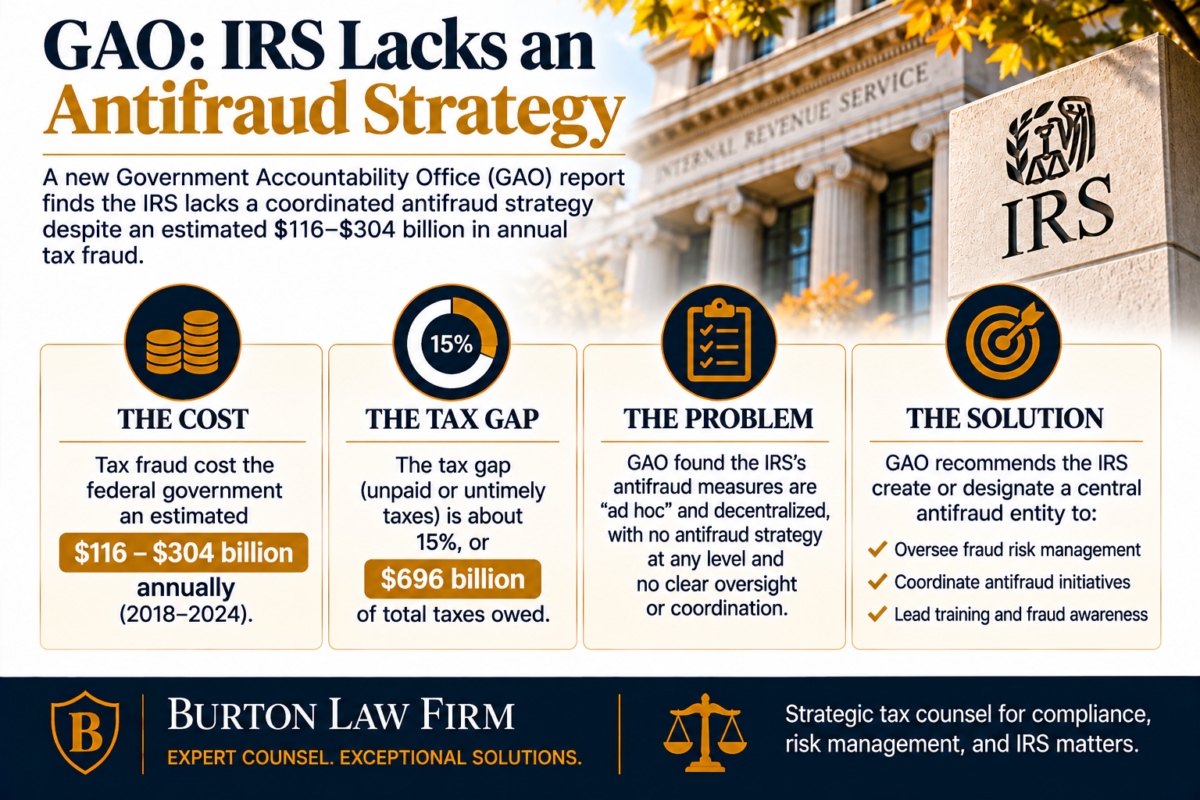
The Government Accountability Office (GAO) estimated that tax fraud cost the federal government between $116 billion and $304 billion annually from 2018 through 2024.[1] The tax gap (unpaid or untimely taxes due to noncompliance) is about 15% or $696 billion of the total tax owed to the IRS. About 17% to 43% of the tax gap is due to fraud. In turn, this represents about 2% to 6% of the total taxes owed to the federal government. In comparison, the IRS recommended an annual average of $24.9 billion in additional taxes through audits during this period.
The extent of this fraud is far from inevitable. GAO described IRS antifraud measures as “ad hoc” and decentralized. “According to officials with the Office of the Chief Risk and Control Officer, IRS does not have an antifraud strategy, and ownership of all antifraud programs and mitigations remains with each division. However, IRS’s divisions also do not have antifraud strategies at the operating level.” To reiterate, “none of the divisions with key antifraud responsibilities have an antifraud strategy.” GAO lamented that “[a]bsent an antifraud strategy at any level, it is unclear which entities within IRS are responsible for managing tax fraud risks, how the agency plans to manage tax fraud risks, and its timeline for doing so.” Consequently, the “IRS’s critical tax fraud risk management activities do not have oversight and coordination,” and the “IRS lacks assurance that individual divisions are developing and implementing antifraud strategies and tax fraud controls.”
As a solution, GAO urged the IRS to create or designate an “antifraud entity” which:
- designs and oversees fraud risk management activities;
- coordinates antifraud initiatives across the program, including facilitating communication with management and among stakeholders on fraud-related issues;
- serves as the repository of knowledge on fraud risks and controls;
- manages the fraud risk assessment process; and
- leads, or assists with, trainings and other fraud-awareness activities.
The IRS’s response was contradictory. It simultaneously claimed that “[t]he IRS Chief Tax Compliance Officer is the responsible entity for coordinating division tax fraud initiatives” and that “[r]esponsibility for tax fraud prevention, detection, and treatment is appropriately distributed across multiple organizations.” However, the IRS specifically rebutted the notion that the IRS Chief Tax Compliance Officer is the central anti-fraud authority. “[O]fficials told us that the Office of the Chief Risk and Control Officer is not IRS’s designated antifraud entity. Further, these officials stated that IRS does not have a designated antifraud entity.”
[1] This regards only the IRS, which collects 86% of all federal revenue. About 11% is collected by other agencies in the form of user or regulatory fees. The remaining 3% is tax revenue by non-IRS agencies, especially through customs duties collected by the Department of Homeland Security.