
Introduction, Structure, and Applicability
Introduction
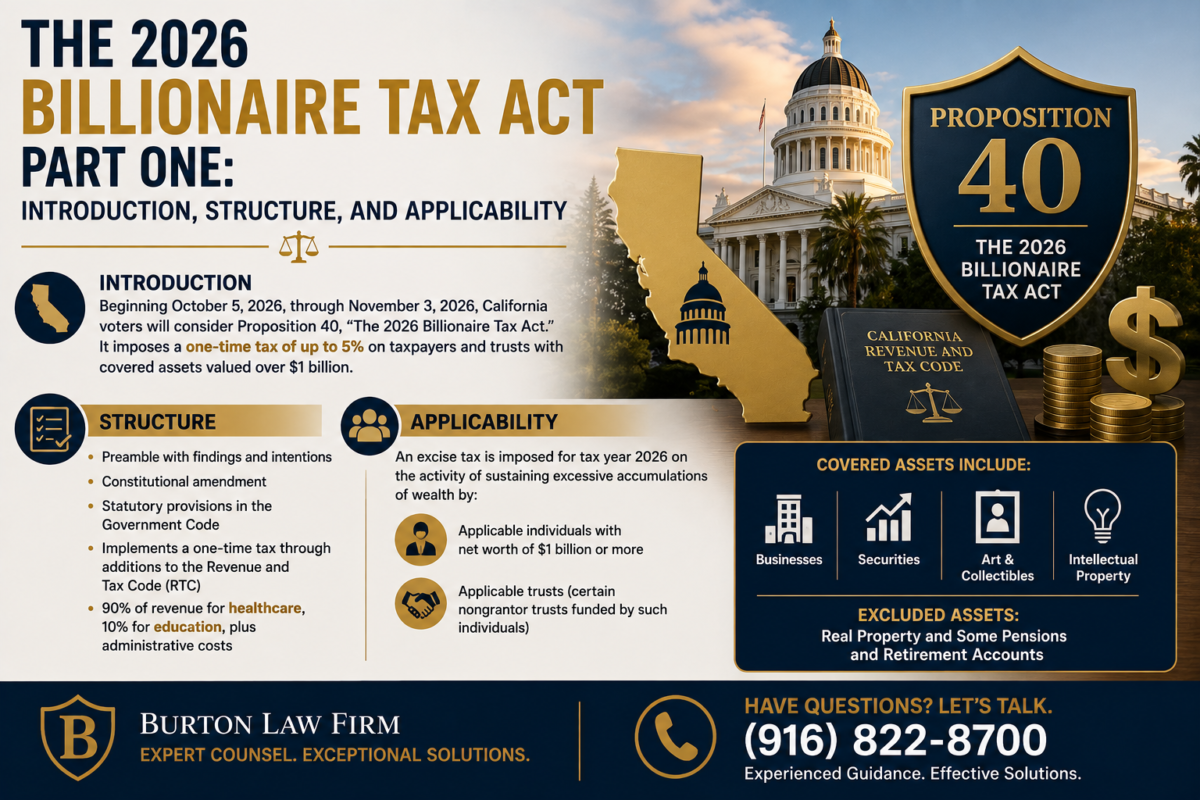
Beginning on October 5, 2026, and ending on November 3, 2026, California voters will consider Proposition 40, “The 2026 Billionaire Tax Act.” As part of Proposition 40’s official summary, prepared by California’s Attorney General, states: It “[i]mposes one-time tax of up to 5% on taxpayers and trusts with covered assets valued over $1 billion; covered assets include businesses, securities, art, collectibles, and intellectual property, but exclude real property and some pensions and retirement accounts.” However, there are many nuances varying from the graduated rate to the definition of “net worth” that will be comprehensively covered in this new series of posts in the coming weeks.[1]
Structure
Proposition 40 is divided into a preamble listing its findings and intentions, a constitutional amendment, and several statutory sections. The preamble explains that Proposition 40 is necessary (according to its creators) to adjust to decreases in federal public health funding. More fundamentally, Proposition 40 cites distributional justice concerns. For example, it claims that: “California has around 200 billionaires who collectively possess an astonishing $2 trillion in wealth. These billionaires pay less than 1.5% of their total wealth in annual taxes, including federal, state, and local taxes, according to leading economic estimates-a small fraction of what ordinary Californians pay.”[2]
The constitutional amendment “authorizes and enables a one-time tax on the accumulated wealth of California billionaires.”[3] Yet, most of the constitutional amendment governs the spending of the 2026 Billionaire Tax Act’s revenue and is followed by implementing sections in the Government Code. Ninety percent of the total revenue (anticipated by supporters to be $100 billion) would be devoted to healthcare, with the rest for public education, apart from yearly administrative expenses for the Franchise Tax Board in enforcing the “2026 Billionaire Tax Act.”[4] The bulk of Proposition 40 consists of additions to the Revenue and Tax Code of California (“RTC”) to implement the wealth tax by the Franchise Tax Board (“FTB”).
Applicability
“An excise tax is imposed for tax year 2026 on the activity of sustaining excessive accumulations of wealth by applicable individuals with net worth of $1 billion dollars ($1,000,000,000) or more, and on applicable trusts.”[5] A 2026 Billionaire Tax Act taxpayer would be either an “applicable individual” with a net worth of at least $1 billion or an “applicable trust.” The term “applicable trust” has a more complex definition, but it is intended to encompass nongrantor trusts that received contributions by an “applicable individual” with a net worth of at least $1 billion.
Applicable Individual
An “‘[a]pplicable individual’ means, for the 2026 tax year, any individual who is a resident of this State, within the meaning of Sections 17014 and 17015.5, as of the tax obligation date.”[6] The tax obligation date is January 1, 2026. Therefore, an individual meeting the wealth threshold is liable for the tax if they were considered a resident of California under the normal state income tax for any part of the year as of January 1, 2026. “[A] married couple shall be considered as one individual” for the purposes of the tax liability and the filing requirement.[7]
Applicable Trust
An “applicable trust” is defined as a “trust” for which all of the following are true:[8]
- The trust is not a grantor trust for the purposes of the income tax.
- The trust is not a tax-exempt trust under IRC § 501.
- An “applicable individual” transferred property to the trust, wherein all of the following are true.
- The applicable individual is “still living.”
- Proposition 40 does not specify when the applicable individual must be alive.
- The applicable individual has a “net worth” of at least $1 billion.
- Proposition 40 does not specify when the net worth threshold must be met for these purposes.
- The applicable individual is “still living.”
The transfer by such an applicable individual is deemed accomplished if performed by “any entity that would constitute a related person with respect to such individual.”[9] Proposition incorporates Internal Revenue Code §§ 267 and 318 (“as of January 1, 2026”) for the definition of a related person.[10] This generally includes close family members and controlled entities. However, a “related person” also includes “any other person so specified by regulations adopted by the Board.”[11] “If more than one individual has transferred property to such trust,” the trust portion which is “treated as an applicable trust” is the portion proportionate to such an applicable individual’s transfer (including through a related entity), “holds to the total value of assets transferred to the trust.”[12] Thus, if an applicable individual (still living with a billion dollars) contributes to a trust alongside a nonapplicable individual in equal proportions, 50% of the trust would be deemed the applicable trust. This definition is modified by two different elections:
- “[A]ny trust may elect to be an applicable trust by notifying the Board of such election by any method the Board may designate.”[13]
- “An individual with net worth of $1 billion ($1,000,000,000) or more who has transferred property to an applicable trust may elect to treat such trust as part of the net worth of such individual by notifying the Board of such election by any method the Board may designate.”[14]
Therefore, a trust can elect to be an applicable trust, and an individual 2026 Billionaire Tax Act taxpayer may elect to incorporate the trust’s assets into their own net worth.
Please visit next week for more information about Proposition 40 in this new weekly series of posts.
[1] Nothing should be construed as support of or opposition to Proposition 40 by the author or The Burton Law Firm.
[2] Proposition 40, § 2(r).
[3] Proposed California Constitution, Art. XIII, § 37(a).
[4] Proposed California Constitution, Art. XIII, § 37(d).
[5] Proposed RTC § 50301(a).
[6] Proposed RTC § 50308(a).
[7] Proposed RTC § 50301(a).
[8] Proposed RTC § 50308(b).
[9] Id.
[10] Proposed RTC § 50308(k).
[11] Id.
[12] Proposed RTC § 50308(b).
[13] Id.
[14] Id.