
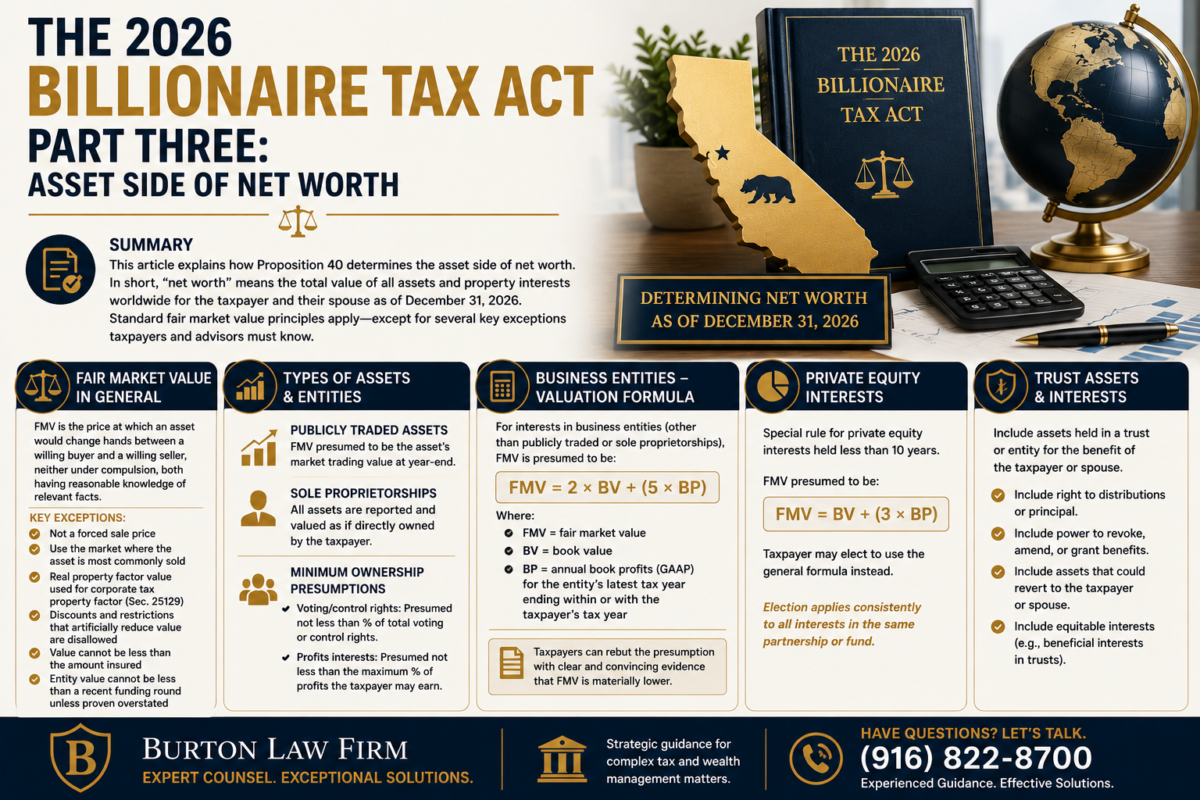
Welcome to part three of this series on Proposition 40, “The 2026 Billionaire Tax Act.”[1] This article discusses how net worth is determined on the asset side. In summary, “‘[n]et worth’ means the total value of all assets and property interests taken into account for the taxpayer and their spouse worldwide under Section 50303 [regarding fair market value] and other applicable provisions of this Part as of” December 31, 2026.[2] Usually, standard fair market value principles apply. Yet there are several important exceptions that taxpayers and their advisors need to be aware of. The next part will discuss the debt side of net worth, as well as the exclusions from “net worth.”
Fair Market Value in General
In general, “the fair market value of each asset owned by a taxpayer is the price at which the asset would change hands between a willing buyer and a willing seller, neither being under any compulsion to buy or to sell, and both having reasonable knowledge of relevant facts.”[3] However, Proposition 40 would provide many exceptions to this rule and empower the FTB to make more.[4] For example, “[t]o the extent valuation of real property is required, the value used for calculating the property factor of the Corporate Income Tax, under Section 25129, is to be used.”[5] The 2026 Billionaire Tax Act would anticipate and attempt to preempt certain strategies, such as discounting and restricted shares. “Any feature of an asset, such as a shareholder rights plan, shall not be taken into account in determining the asset’s value where a significant purpose and effect of adding the feature is to reduce the appraised value of the asset. No valuation or other discount shall be taken into account if such discount would have the effect of reducing the value of a partial interest in an asset below the taxpayer’s pro rata portion of the value of the entire asset.”[6]
There are other rules binding the taxpayer to a form of estoppel. “In no case shall the value of an asset be determined to be less than the amount for which such asset is insured.”[7] Also, “[i]n the case of a business entity, in no case shall the value of such entity be less than the valuation reflected in any funding round or other sale of equity occurring within two years of the valuation date, unless the taxpayer can show by clear and convincing evidence that such valuation would significantly overstate the value of the entity.”[8]
Fair Market Value of Entities
The fair market value of “publicly traded assets” would be “presumed to be the asset’s market trading value at the end of the individual’s tax year.”[9] “[A]ll assets owned by or held through a sole proprietorship shall be reported and valued as though they were directly owned and held by the taxpayer and not through a sole proprietorship.”[10] A minimum amount of ownership is rebuttably imputed regarding rights to control or profit:
- “For any interests that confer voting or other direct control rights, the percentage of the business entity owned by the taxpayer shall be presumed to be not less than the taxpayer’s percentage of the overall voting or other direct control rights.”[11]
- “For any profits interests in a business entity, the percentage of the entity owned by the taxpayer shall be presumed to be not less than the maximum such percentage interest of the entity’s profits the taxpayer may earn, without respect to whether such profits interest is subject to a condition precedent that has not yet been met.”[12]
Apart from the extremes of publicly traded assets and sole proprietorships, “all interests in any business entities, including all equity and other ownership interests, all debt interests, and all other contractual or noncontractual interests,” would be rebuttably “presumed” to be governed by the following equation:[13]
- “FMV” means fair market value.
- “BV” means book value.
- “BP” is “the annual book profits of the business entity—as averaged over the current tax year and the preceding two tax years—according to generally accepted accounting principles,” but not below zero.
- “TP” is the taxpayer’s percentage interest.[14]
There is a special rule for a private equity entity whereby the fair market value of such entity must at least be equal to the fair market value of each entity it owns minus the private equity entity’s liabilities. “In the case of a private equity entity, this value shall not be less than the sum of the value (as determined under [the above formula]) of each entity owned by the private equity entity, over the liabilities (other than profits interests) of the private equity entity.”[15] “‘Private equity entity’ means a business entity, other than a publicly traded entity, mutual fund, or exchange-traded fund, that engages primarily in the business of investing in other businesses.”[16]
A limited degree of discretion is given to the FTB and the taxpayer regarding valuations. “The Board may permit a taxpayer to compute book value and book profits using an accounting method other than generally accepted accounting principles if the business to be valued consistently maintains its books and records and reports income and expenses using such other method.”[17] The presumption regarding the ownership interests of entities regarding control and profits, as well as the specified calculation of fair market value for entities other than publicly traded assets and sole proprietorships, can be rebutted by either the FTB or the taxpayer if the proponent “can demonstrate with clear and convincing evidence” that these rules “would substantially overstate or understate the actual value of the business entity owned by the taxpayer or the percentage owned by the taxpayer.”[18] The term “clear and convincing evidence” has a well-established meaning in caselaw, requiring proof “sufficiently strong to command the unhesitating assent of every reasonable mind.”[19]
In such cases, “the taxpayer or the Board may instead submit a certified appraisal of the percentage of the business entity owned by the taxpayer and then use the certified appraisal value in place of the presumed percentage method.”[20]
Fair Market Value of Trusts
“An individual’s net worth includes the net worth of any grantor trust of that individual.”[21] For the 2026 Billionaire Tax Act, a “grantor trust” is defined as “any trust which would be a grantor trust for purposes of the income tax, and also any trust the assets of which would be included in the estate of the grantor for purposes of federal transfer tax.”[22] There are two sets of rules regarding nongrantor trusts. Solely “[f]or purposes of determining whether an individual’s net worth is in excess of $1 billion ($1,000,000,000) or $1.1 billion ($1,100,000,000),” thereby triggering the Proposition 40 tax, “net worth shall include the value of property held by any trust (other than a grantor trust or tax-exempt trust) to which the individual transfers or has transferred property.”[23]
The second set of rules applies to “all purposes.” Net worth would “include the value of property held by any trust (other than a grantor trust or tax-exempt trust) to which the individual transfers property in 2026, and seventy-five percent of the value of such property transferred in 2025,” but only “[t]o the extent consistent with the U.S. and California Constitutions.”[24] Assets are at risk of being taxed thrice, or more precisely, 2.75 times. For example, if a single individual created a non-grantor trust in 2025 and funded it with $1 million in that year and another $1 million in 2026, the individual would be taxed both on the value of the trust at the end of 2026 plus 75% of the $1 million transferred in 2025, while the trust would be separately taxed on its value.
“If more than one individual has transferred property to any such trust,” the net worth is increased by the proportion of the trust reflecting the individual’s proportionate contribution to the trust.[25] A trust beneficiary, “whether or not the trust is resident in California,” would “be deemed the owner of the trust’s assets to the extent that the assets are distributable to the beneficiary, whether distributed or not,” unless “the trust is an applicable trust,” and therefore taxed itself under Proposition 40.[26]
[1] Nothing should be construed as support of or opposition to Proposition 40 by the author or The Burton Law Firm.
[2] Proposed RTC § 50308(f).
[3] Proposed RTC § 50303(a). As if it were not already incorporated into the definition, the proposed statute elaborates that “[t]he fair market value of an asset shall not be” either “[t]he price that a forced sale of the property would produce; or [t]he sales price in a market other than that in which the property is most
commonly sold to the public, if the price in such market would result in a lower fair market value, except in the case of property subject to Section 423, relating to the valuation of restricted open-space land.” Proposed RTC § 50303(a).
[4] Proposed RTC § 50309(b).
[5] However, real estate is excluded from net worth. Proposed RTC § 50303(c)(4).
[6] Proposed RTC § 50302(b).
[7] Proposed RTC § 50303(c)(10).
[8] Proposed RTC § 50303(c)(10).
[9] Proposed RTC § 50303(c)(1).
[10] Proposed RTC § 50303(c)(2).
[11] Proposed RTC § 50303(c)(3)(C).
[12] Proposed RTC § 50303(c)(3)(D).
[13] Proposed RTC § 50303(c)(3)(E).
[14] In text form: “[T]he fair market value of those interests at the end of any tax year shall be presumed to be the sum of the book value of the business entity according to generally accepted accounting principles as of the end of the tax year plus a present-value multiplier of 7.5 times the annual book profits of the business entity—as averaged over the current tax year and the preceding two tax years, if available—according to generally accepted accounting principles, with this entire sum then multiplied by the percentage of the business entity owned by the taxpayer as of the end of the tax year.” Proposed RTC § 50303(c)(3)(E).
[15] Proposed RTC § 50303(c)(3)(E).
[16] Proposed RTC § 50308(i).
[17] Proposed RTC § 50303(c)(3)(E).
[18] Proposed RTC § 50303(c)(3)(F).
[19] Conservatorship of O.B., 9 Cal. 5th 989, 998 fn.2 (2020).
[20] Proposed RTC § 50303(c)(3)(F).
[21] Proposed RTC § 50303(c)(6)(A).
[22] Proposed RTC § 50308(e).
[23] Proposed RTC § 50303(c)(6)(B).
[24] Proposed RTC § 50303(c)(6)(B).
[25] Proposed RTC § 50303(c)(6)(B).
[26] Proposed RTC § 50303(c)(6)(C).