
Introduction
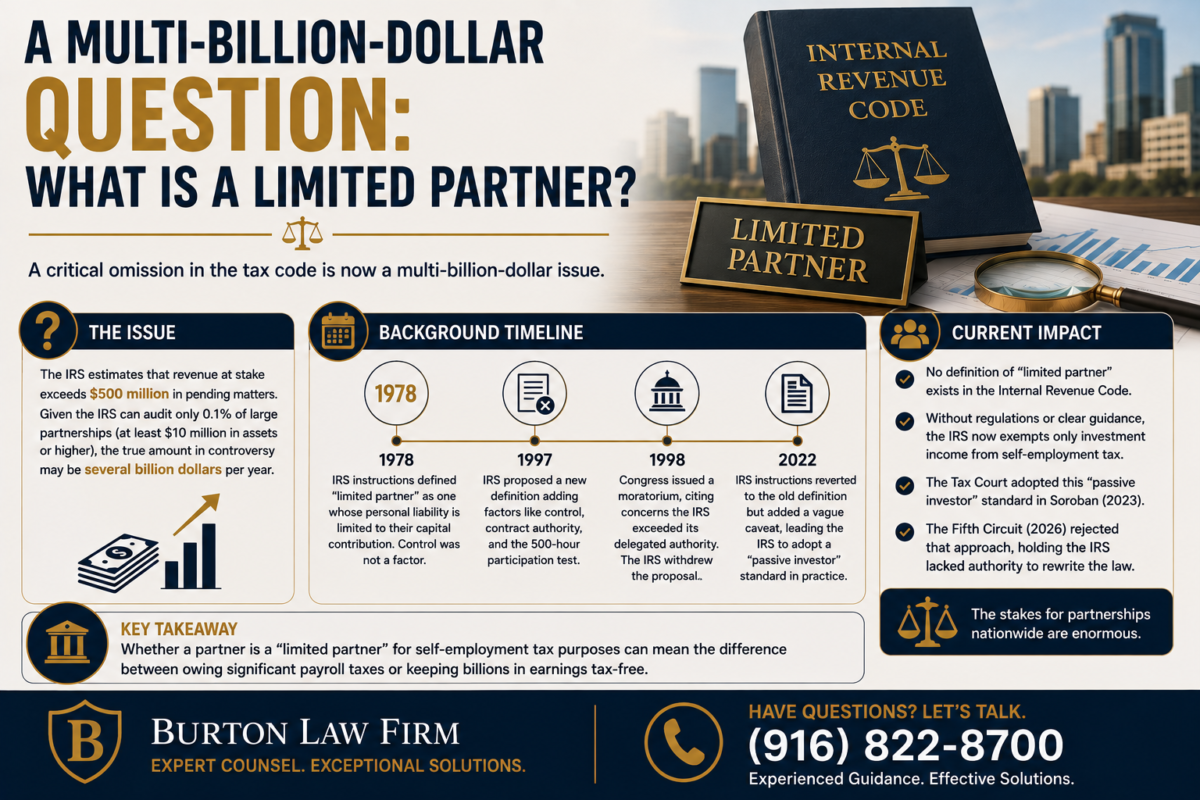
Wages are generally subject to payroll taxes. Self-employed individuals are instead subject to a separate yet parallel tax designed to correspond to the payroll tax burden.[1] Self-employment income generally includes “distributive shares of partnership income in net earnings from self-employment.”[2] Section 1402(a)(13) provides an exception excluding “the distributive share of any item of income or loss of a limited partner, as such, other than guaranteed payments described in section 707(c) to that partner for services actually rendered to or on behalf of the partnership to the extent that those payments are established to be in the nature of remuneration for those services.”[3] However, the Internal Revenue Code does not define the term “limited partner.” This is a critical omission. “The IRS estimates that revenue at stake exceeds $500 million, just in pending matters.” Since the IRS can only audit, let alone litigate, 0.1% of large partnerships (at least $10 million in assets or higher), the true amount in controversy may well be several billion dollars per year.
Background
The limited partner exception to the self-employment tax came into effect in 1978. In the same year, “the IRS issued partnership tax return instructions that defined ‘Limited Partner’ as ‘one whose potential personal liability for partnership debts is limited to the amount of money or other property that the partner contributed or is required to contribute to the partnership.’”[4] Control over the partnership was not mentioned as a factor for this exception for over forty years.
Nevertheless, the IRS attempted to define a “limited partner, as such,” in 1997. “The proposed regulation provided that an individual would not be treated as a limited partner if the individual had personal liability for partnership debts, had authority to contract on behalf of the partnership, or participated in the partnership’s trade or business for more than 500 hours during the partnership’s taxable year.”[5] The IRS did not alter its instructions to conform to its proposed regulations. The proposed regulations caused some alarm in Congress, which issued a moratorium on that proposed regulation until 1998, citing concerns that the IRS exceeded its delegated authority. The IRS did not pursue the regulation further.
Suddenly on January 7, 2022, the IRS published instructions “defining ‘limited partner’ in the same way the instructions did in the past,” but with “a vague possible caveat: ‘However, whether a partner qualifies as a limited partner for purposes of self-employment tax depends upon whether the partner meets the definition of a limited partner under section 1402(a)(13).’”[6] There was no indication that this definition contradicted the definition of limited partner given earlier in the instructions. This remains the case today.[7] Yet, without a regulation or even clear published guidance, the IRS began to limit the limited partner definition to exempt only investment income.[8] This “passive investor” standard was adopted by the Tax Court in 2023 through Soroban Capital Partners LP v. Commissioner. The 5th Circuit reversed the Tax Court’s definition in a separate case, Sirius Solutions, L.L.L.P. v. Commissioner, on January 16, 2026: “We hold that a ‘limited partner’ in § 1402(a)(13) is a limited partner in a state-law limited partnership that is afforded limited liability.”[9] The IRS petitioned for an en banc rehearing of this decision by the 5th Circuit. The court denied this petition, yet withdrew its prior opinion and substituted a new one on August 12, 2026.
K Alain, L.L.L.P. v. Commissioner
The case was retitled from Sirius Solutions, L.L.L.P. v. Commissioner to K Alain, L.L.L.P. v. Commissioner, to reflect the partnership’s name change. The new opinion is less than half the old opinion’s length and was written as if the old opinion never existed. Although the 5th Circuit did not discuss why the old opinion was withdrawn, there are material differences between the opinions despite the same basic ruling in the taxpayer’s favor. The old opinion created a bright-line rule that any partner with limited liability under state law is a limited partner, adopting the historical partnership tax return instructions issued by the IRS. In contrast, the new opinion stated: “We hold the ordinary public meaning of this phrase is a partner who plays no significant role in managing or running a business.”[10]
K Alain, L.L.L.P. v. Commissioner used dictionaries, contemporaneous academic treatises, nontax contemporaneous caselaw, and state law to reach “the ordinary understanding of ‘limited partner’ in 1977,” when the exception was enacted.[11] “At bottom, all relevant sources suggest that, in 1977, the ordinary public meaning of ‘limited partner’ included a partner who did not play a significant role in managing or running the business.”[12] This was a straightforward matter, according to the 5th Circuit: “Here, we apply the plain text. Nothing more.”[13] It rejected “the dissent’s parade of horribles,” explaining that “this court’s job is to discern and apply the law’s plain meaning as faithfully as we can, not ‘to assess the consequences of each approach and adopt the one that produces the least mischief.”[14] Although Alain cited the historical interpretation of the IRS as a reason for its ruling, the ruling did not depend on prior practice.
Alain’s withdrawn opinion and over four decades of IRS instructions held that a limited partner is simply a partner with limited liability. The 5th Circuit rejected that standard by adding the condition that the partner must “not play a significant role in managing or running the business.”[15] Alain did not explain why. The taxpayer in Alain won in that the 5th Circuit vacated the unfavorable Tax Court judgment. However, the partnership could still lose on remand. The Tax Court is now tasked with determining whether the limited partners’ involvement was “significant.” Alain gave little guidance on how that is accomplished. Instead, Alain issued a sharp rebuke of the Tax Court for its opinion in Soroban:
With just a few sentences of operative analysis—citing no contemporary textual authority—the Tax Court insisted that ‘limited partner, as such’ somehow denoted more than limited liability. The Tax Court then said, without significant analysis, that this required a ‘passive investor’ rule. The Tax Court made no attempt to ground its rule in the original public meaning of “limited partner” in 1977.[16]
This may influence whether the Tax Court will follow Alain outside of the 5th Circuit.
Broader Context
Alain did not settle the controversy over the limited partner exception to the self-employment tax. The Tax Court “adheres to the doctrine of stare decisis” and “takes seriously its obligation to facilitate uniformity in the tax law” as a nationwide court.[17] “When one of our decisions is reversed by an appellate court, the Court will thoroughly reconsider the problem in the light of the reasoning of the reversing appellate court and, if convinced thereby, follow the higher court.”[18] Yet if “convinced that our original decision was right, the proper course is to follow our own honest beliefs until the Supreme Court decides the point.”[19] Nevertheless, it will follow a contrary appellate decision when both the decision is “squarely on point,” and an appeal from the Tax Court would rest in the circuit court that issued the contrary decision.[20] “To do otherwise would be futile and wasteful given the inevitable reversal from the appellate court.”[21] Therefore, the Tax Court will likely comply with Alain within the 5th Circuit, but it will still need to be convinced to apply it elsewhere.
The self-employment tax and the payroll taxes fund Social Security and Medicare. This funding will be insufficient for Social Security beginning in 2033 and for Medicare beginning in 2033, whereby only 77% and 89% of their respective scheduled benefits will be distributed.
[1] Overview of the Federal Tax System as in Effect for 2025 at 27.
[2] Soroban Capital Partners LP v. Commissioner, 161 T.C. 310, 316 (2023).
[3] IRC § 1402(a)(13).
[4] Alain v. Commissioner, No. 24-60240, 2026 U.S. App. LEXIS 24366, at *13 (5th Cir. Aug. 12, 2026).
[5] Soroban Capital Partners LP v. Commissioner, 161 T.C. 310, 317 (2023).
[6] Sirius Sols. L.L.L.P. v. Commissioner, 165 F.4th 374, 380 (5th Cir. 2026) withdrawn by Alain v. Commissioner, No. 24-60240, 2026 U.S. App. LEXIS 24366(5th Cir. Aug. 12, 2026).
[7] Thus, the 2025 Instructions for Form 1065 states at page 3 that: “A limited partner is a partner in a partnership formed under a state limited partnership law, whose personal liability for partnership debts is limited to the amount of money or other property that the partner contributed or is required to contribute to the partnership.” Furthermore, the instructions provide at page 44: Generally, a limited partner’s share of partnership income (loss) isn’t included in net earnings (loss) from self-employment. Limited partners treat as self-employment earnings only guaranteed payments for services they actually rendered to, or on behalf of, the partnership to the extent that those payments are payment for those services. However, whether a partner qualifies as a limited partner for purposes of self-employment tax depends on whether the partner is considered a limited partner under section 1402(a)(13).”
[8] The 5th Circuit emphasized the magnitude of this shift:
The Commission’s position in this case is that it can change the meaning of “limited partner” from (A) “limited liability alone,” which was the pre-Soroban standard, to (B) Soroban’s “passive investor” standard—with zero action from Congress to amend § 1402(a)(13)’s text. Perhaps that level of administrative control over billions or trillions of dollars in tax liability is permissible as a general matter. But at a minimum, even assuming the Commissioner can unilaterally effectuate such changes through tax instructions, its instructions must comport with the original public meaning of the text enacted by Congress in 1977.
Alain v. Commissioner, No. 24-60240, 2026 U.S. App. LEXIS 24366, at *14 (5th Cir. Aug. 12, 2026).
[9] Sirius Sols. L.L.L.P. v. Commissioner, 165 F.4th 374, 388 (5th Cir. 2026) withdrawn by Alain v. Commissioner, No. 24-60240, 2026 U.S. App. LEXIS 24366(5th Cir. Aug. 12, 2026).
[10] Alain v. Commissioner, No. 24-60240, 2026 U.S. App. LEXIS 24366, at *6 (5th Cir. Aug. 12, 2026).
[11] Id. at *9.
[12] Id. at *11.
[13] Id.
[14] Id.(omitting internal quotation marks).
[15] Id.
[16] Id. at *12(omitting internal citations; emphasis added by Alain).
[17] Mukhi v. Comm’r of Internal Revenue, 163 T.C. No. 8 at *2 (2024).
[18] Id.(omitting internal quotation mark and ellipsis).
[19] Id.(omitting internal quotation mark and brackets).
[20] Id.(omitting internal brackets).
[21] Id.(omitting internal quotation marks).