
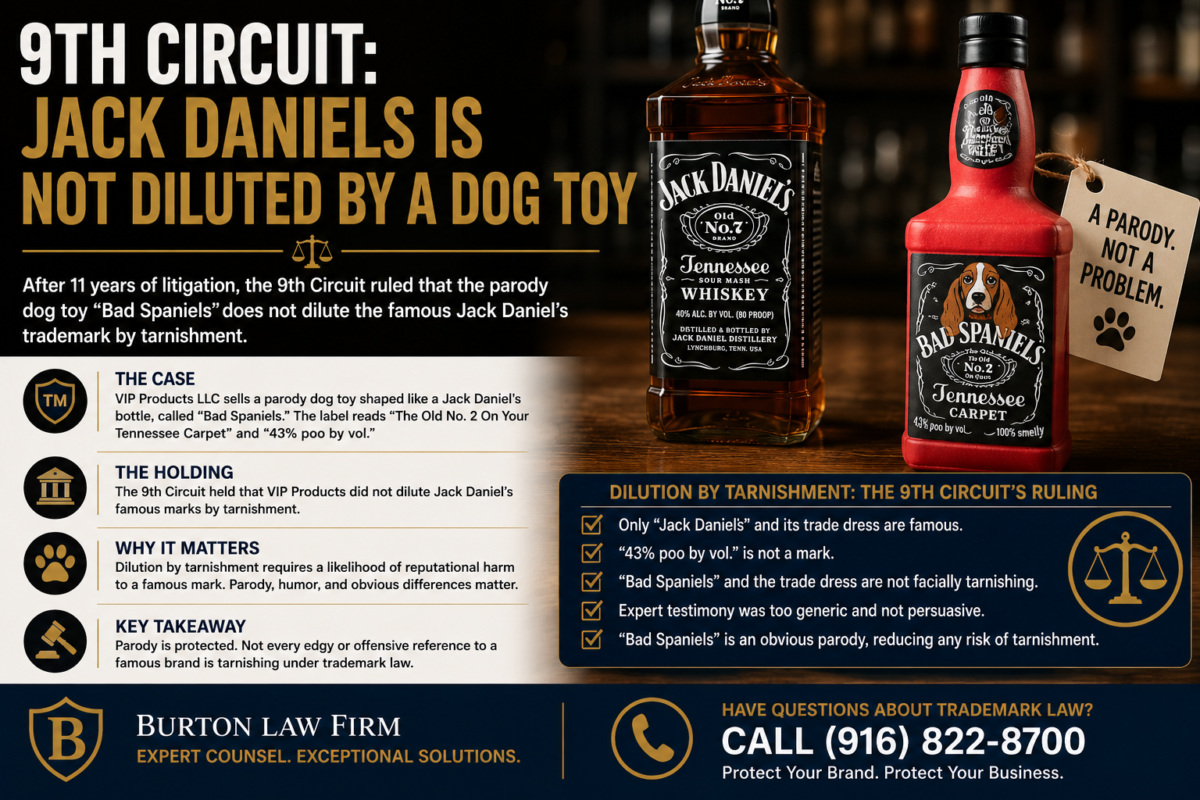
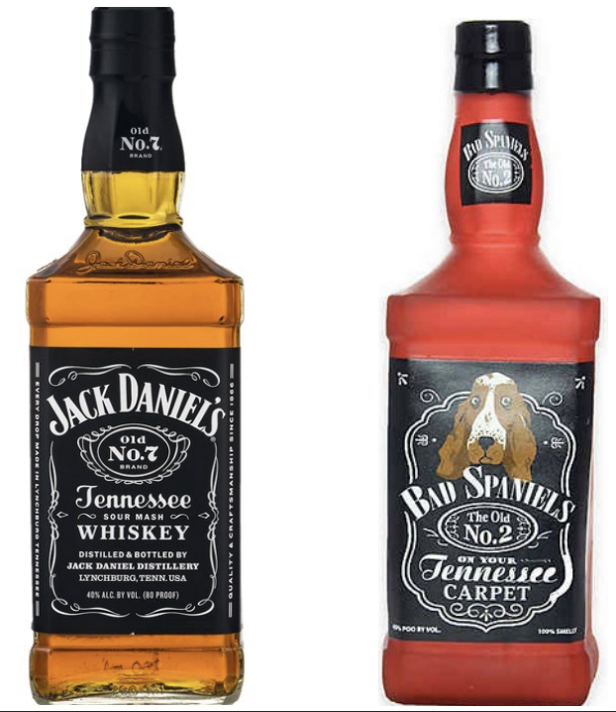
After 11 years, the litigation between Jack Daniel’s Properties, Inc. and VIP Products LLC regarding a dog toy’s resemblance to liquor ended in VIP Products LLC’s favor. VIP Products LLC sells dog toys parodying Jack Daniel’s beverage. The toys are similarly shaped (but of different materials) and are called “Bad Spaniels,” with a descriptive label of “The Old No. 2 On Your Tennessee Carpet” instead of “Old No. 7 Brand Tennessee Sour Mash Whiskey.” “The small print at the bottom substitutes ‘43% poo by vol.’ and ‘100% smelly’ for ‘40% alc. by vol. (80 proof).’”[1]
The Lanham Act protects trademarks from confusion and dilution. This case already reached the Supreme Court in 2023, which instructed the 9th Circuit on the proper standard.[2] In turn, the 9th Circuit remanded the case to the district court. The district court ruled that the liquor cannot likely be confused with the dog toy, so the dog toy does not infringe on the liquor’s trademark. However, VIP Products LLC was held liable for dilution by tarnishment. VIP Products LLC appealed the dilution by tarnishment judgment, but Jack Daniel’s Properties, Inc. (JDPI) did not appeal the infringement ruling.
“Dilution by tarnishment means an association arising from the similarity between a mark or trade name and a famous mark that harms the reputation of the famous mark.”[3] Consumer confusion is irrelevant. However, this action “protects only famous marks from dilution and only where a similar junior mark is likely to tarnish its reputation because of the marks’ association.”[4] Here, the Jack Daniel’s liquor was compared with canine feces. Yet, “[t]he only marks JDPI proved famous are ‘Jack Daniel’s’ and its registered trade dress.”[5] “[A] mark is famous if it is widely recognized by the general consuming public of the United States as a designation of source of the goods or services of the mark’s owner.”[6] To qualify, “the mark must be a ‘household name.’”[7] The most objectionable detail, “43% poo by vol.” simply “does not mimic or reproduce any famous, similar mark. The equivalent language on JDPI’s product, ‘40% ALC. BY VOL. (80 PROOF),’ is not a mark.”[8] Therefore, “the only similar junior marks for our review are ‘Bad Spaniels’ and the dog toy’s trade dress.”[9] The “trade dress” is “the overall appearance of a product and its packaging.”[10] Neither the trade dress nor the name is facially tarnishing. “If a junior mark is not facially tarnishing, the context in which it is used may become relevant to the tarnishment analysis, depending on the facts of the case. For example, using a famous mark or a closely related depiction on a product that is of poor quality or pornographic or illegal may be tarnishing if the other requisites are met.”[11]
Here, the district court and JDPI relied on an expert witness to conclude that there is tarnishment. The 9th Circuit rejected that testimony as “generic.”[12] Although Dr. Simonson stated that aversion usually occurs when excrement is associated with a beverage, he did “not show that any association between either ‘Bad Spaniels’ and ‘Jack Daniel’s’ or between the products’ similar trade dress is likely to damage the reputation of JDPI’s famous marks.”[13] The studies he cited were not specific to this case, and “Bad Spaniels is a parodic dog toy not intended for human consumption.”[14] Finally, “Bad Spaniels is an obvious parody.”[15] Although not dispositive per se, “clarity of VIP’s parodic intent impacts the likelihood that JDPI’s famous marks are harmed by association with VIP’s product.”[16] This is so because “no matter how similar to its famous counterpart, a parodic junior mark ultimately relies upon a difference from the original mark, presumably a humorous difference, in order to produce its desired effect.”[17] Therefore, the 9th Circuit ordered the district court to vacate its permanent injunction and enter judgment in favor of VIP.
If you are considering registering a trademark or if you have any trademark questions, please call 916-822-8700 or email info@lawburton.com.
[1] Jack Daniel’s Props. v. VIP Prods. LLC, 599 U.S. 140, 150 (2023).
[2] Specifically, the Rogers test does not apply when “the use is at least in part for source identification—when the defendant may be trading on the good will of the trademark owner to market its own goods.” Jack Daniel’s Props. v. VIP Prods. LLC, 599 U.S. 140, 156 (2023)(omitting internal quotation marks). The “Rogers test requires dismissal of an infringement claim at the outset unless the complainant can show one of two things: that the challenged use of a mark has no artistic relevance to the underlying work or that it explicitly misleads as to the source or the content of the work.” Id. at 151(omitting internal quotation marks).
[3] VIP Prods., Ltd. Liab. Co. v. United States, No. 25-2027, 2026 U.S. App. LEXIS 23257, at *12 (9th Cir. Aug. 4, 2026)(omitting internal quotation marks).
[4] Id. at *13-14.
[5] Id. at *14.
[6] Id. at *16.
[7] Id.
[8] Id. at *14 fn.3.
[9] Id. at *14.
[10] Id. at *12.
[11] Id. at *20.
[12] Id. at *23.
[13] Id. at *23-24.
[14] Id. at *24(emphasis in original).
[15] Id. at *26.
[16] Id. at *27(omitting internal brackets and quotation marks).
[17] Id. at *28(omitting internal quotation mark).