
The Americans with Disabilities Act (ADA) generally requires publicly accessible businesses to be accessible to individuals with disabilities. Wheelchair ramps are perhaps the most visible feature required by the ADA, but less tangible accommodations are necessary, too. Courts have adapted this 1990 law to 21st-century needs by requiring many websites to be accessible to people with visual impairments and other disabilities.[1] This does not bind every website, but any establishment subject to the ADA’s physical mandates must comply with the ADA’s virtual mandates.[2]
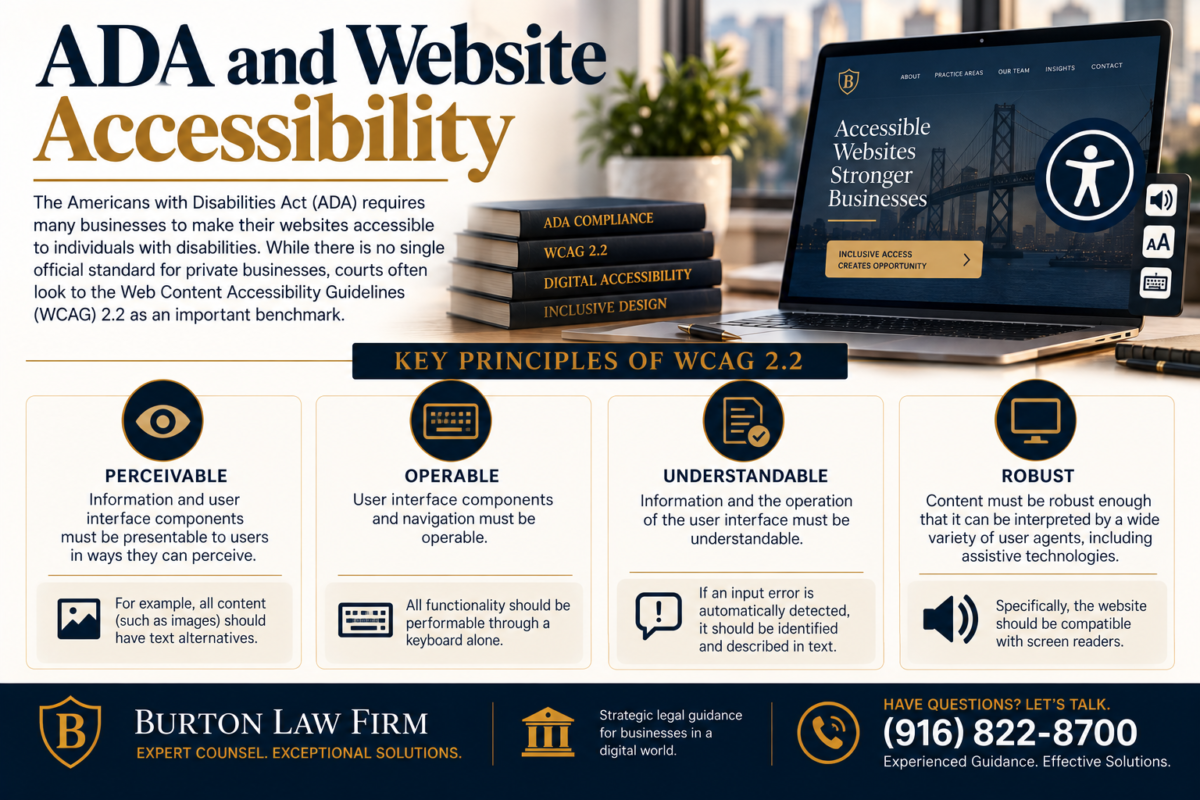
Unfortunately, there is not an official standard for private actors.[3] However, courts often use adherence to the Web Content Accessibility Guidelines (WCAG) promulgated by the World Wide Web Consortium to measure ADA compliance. “A failure to comply with WCAG may not be dispositive of ADA non-compliance, but compliance with this common accessibility standard is certainly helpful and informative in that respect.”[4] Consequently, it is often unclear what exactly is required for minimum accessibility under the ADA, but WCAG conformity can serve as a safe harbor. The latest standard is WCAG 2.2, which urges websites to be:
- Perceivable: “Information and user interface components must be presentable to users in ways they can perceive.”
- For example, all content (such as images) should have text alternatives.
- Operable: “User interface components and navigation must be operable.”
- As one application, all functionality should be performable through a keyboard alone.
- Understandable: “Information and the operation of the user interface must be understandable.”
- For instance, “[i]f an input error is automatically detected, the item that is in error is identified and the error is described to the user in text.”
- Robust: “Content must be robust enough that it can be interpreted by a wide variety of user agents, including assistive technologies.”
- Specifically, the website should be compatible with screen readers.
If there is good news for a defendant in ADA litigation, it is that the lawsuit can be mooted. “Courts routinely declare ADA access claims are moot when defendants modify noncompliant items.”[5] This may be difficult when the demands are on physical architecture, but it may be easier for simpler websites. Nevertheless, detecting WCAG compliance is a technical skill in and of itself. While there are automated detectors, a human-based determination is necessary to be certain. The Burton Law Firm does not endorse any vendor or particular method for either WCAG compliance detection or remediation. Nevertheless, the California Department of Rehabilitation has a list of potential vendors, many of which have been used by the state of California, and a few to an extensive degree. Of course, the Department of Rehabilitation also disclaims any recommendation or endorsement, even for these much-used vendors.
[1] Robles v. Domino’s Pizza, LLC, 913 F.3d 898 (9th Cir. 2019).
[2] Robles v. Domino’s Pizza, LLC, 913 F.3d 898, 905 (9th Cir. 2019).
[3] There is for state and local government entities, though. This uses WCAG 2.1, buttressing its role as a safe harbor for the private sector.
[4] Merrell v. Ralph Lauren Corp., No. 23-cv-06669-HSG, 2026 U.S. Dist. LEXIS 152333, at *19 (N.D. Cal. July 9, 2026).
[5] Merrell v. Tapestry Inc., No. 5:25-cv-02510-RGK-MAR, 2026 U.S. Dist. LEXIS 150519, at *7-8 (C.D. Cal. May 12, 2026).