
Introduction
Pung v. Isabella County is the sequel to the 2023 Supreme Court case Tyler v. Hennepin County. In a foreclosure for a defaulted property tax debt, Tyler held that the Takings Clause requires the government to remit the surplus of foreclosure proceeds over the tax debt. Now, Pung addresses how to measure that surplus. It is simply the difference between the tax debt and the foreclosure proceeds, regardless of the fair market value.
In 2015, Isabella County, Michigan, foreclosed a home for a $2,241.93 property tax debt after lengthy litigation. The home was purchased in 1991 for $125,000. It was assessed at $194,400 at the time of foreclosure, and it was resold about 18 months later by the purchaser for $195,000. However, the property was sold at the foreclosure auction for only $76,008, and Isabella County kept all proceeds. The taxpayer sued for the excess of the fair market value over the debt. The District Court granted the difference between the auction price and the tax debt, but denied the claim regarding the fair market value. The 6th Circuit confirmed in an unpublished opinion.
What is Just?
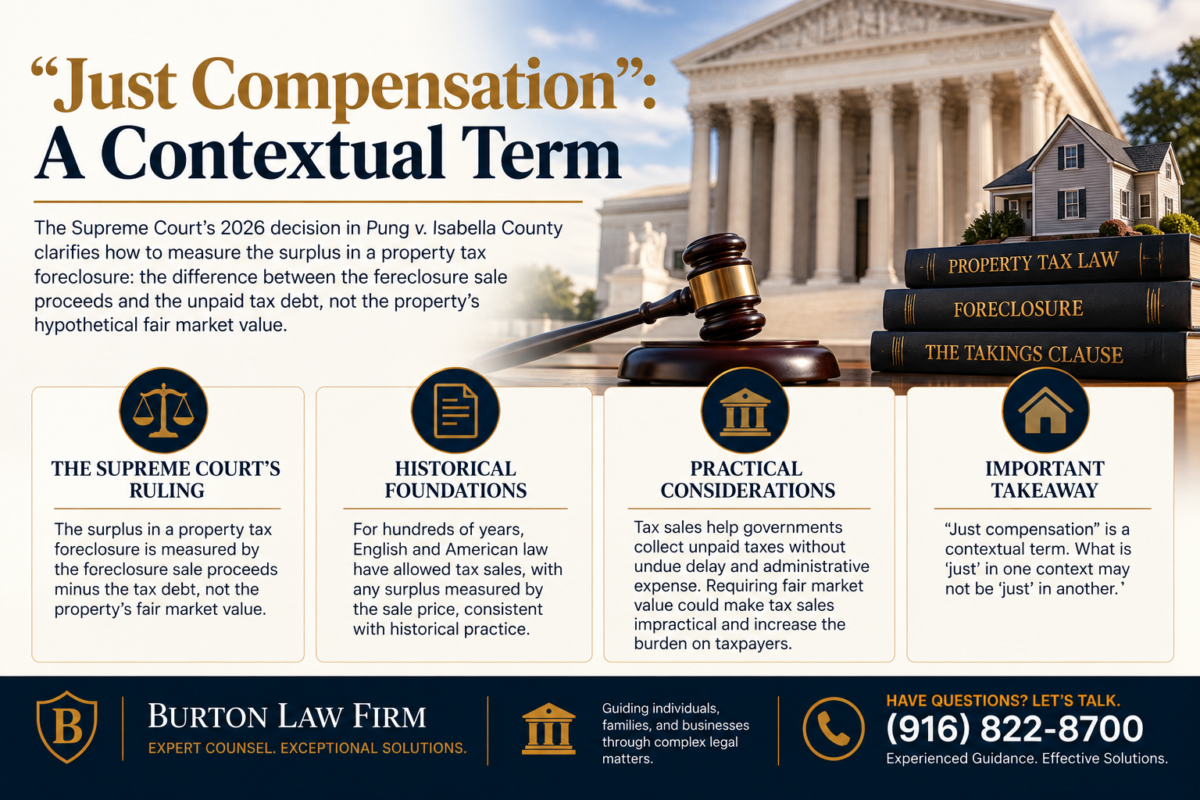
History predetermined the Supreme Court’s ruling. “[F]or hundreds of years, English and American law have allowed the seizure and sale of property as a tax-collection method, provided that the government return any surplus proceeds to the debtor.”[1] Throughout that time, the surplus has been measured as “the sale price, not the property’s hypothetical fair market value.”[2] “[A]t least when the sale is fairly conducted in light of our country’s history of tax sales,” that constitutes “just compensation.”[3] The Court did not examine whether the sale reflects the fair market value. Unquestionably, “the fair market value is the default measure of ‘just compensation’” in eminent domain cases.[4] Yet, even then, “there are situations where this standard is inappropriate” as when the fair market value is “too difficult to find, or when its application would result in manifest injustice to owner or public.”[5] “Just” is a relative construct. “[W]hat is ‘just’ in one context may not be ‘just’ in another.”[6] The Court noted that a property owner facing foreclosure could obtain a loan to pay the taxes or sell the property themselves. “Here, the Pungs had years to take these steps and avoid foreclosure. They failed to do so. In such a situation, the traditional rule, under which the taxpayer receives only the difference between the auction sale price and unpaid taxes, is ‘just.’”[7]
“[T]ax sales are designed to collect unpaid taxes without undue delay and administrative expense,” resulting in suboptimal prices.[8] The alternative “would impose unprecedented burdens on jurisdictions that wish to collect unpaid taxes and might well make tax sales impractical.”[9] Real property sales are time-consuming, costly, and risky. The Court warned that governments would likely need to pay the taxpayer in many situations. “The possibility of such a perverse result would render tax sales infeasible as a debt-collection mechanism,” despite acknowledging that some states do so earlier.[10] Moreover, governments “might well compensate for this lost revenue by increasing the burden on residents who do pay their taxes.”[11] Therefore, tax sales actually benefit taxpayers as a whole.
The Court disclaimed that “[o]ur task in this case, however, is not to decide whether tax sales as historically conducted represent good public policy.”[12] The fact that such tax sales are historically entrenched decides the matter. “If the Takings Clause had been understood to impose restrictions that rendered these sales untenable, they would have presumably faded away, at least after the Fourteenth Amendment incorporated the Takings Clause against the States.”[13] Any interpretation that is contrary to historical practices will likely be poorly received. “That Pung’s novel interpretation of the Takings Clause would whisk this longstanding practice into the dust bin is strong evidence that his interpretation is incorrect.”[14]
The Court dismissed the taxpayer’s arguments regarding the procedure of the sale and the county’s choice to forsake lesser alternatives to foreclosure because they were not part of the question presented before the Court. In contrast, the taxpayer’s Eighth Amendment argument was properly presented to the Court. Nevertheless, the Court’s response to the taxpayer’s claim that the sale amounted to an “excessive fine” was quite brief. It acknowledged that “[f]orfeiture of property can be a fine for purposes of the Eighth Amendment if it serves in part to punish,” but “historical practice” influences this analysis.[15] Here, the taxpayer’s Eighth Amendment argument fails for the same reason as the Fifth Amendment fails. It “lacks historical or precedential support.”[16] Like the “Fifth Amendment theory,” this would also mean “the demise of this country’s longstanding use of tax sales to collect debts.”[17] There was not any further explanation. Unfortunately, the Court did not indicate whether the tax sale constituted a fine or, if so, why it is not excessive.
A Concurring Dissent
According to the Court: “The Pung family lost its property because it failed to pay its taxes.”[18] However, Justice Thomas highlighted details revealing a more nuanced scenario. Pung was unanimously decided with two concurrences, technically speaking. Justice Sotomayor, joined by Justice Gorsuch and Justice Jackson, wrote a brief opinion emphasizing that the Court’s opinion does not have any implications for “identifying the contours of a fair auction.”[19] In contrast, Justice Thomas’s opinion was longer than the Court’s opinion. Although he joined all but one section of the majority opinion, Justice Thomas’s concurrence was more of a dissent.[20] Justice Thomas, joined by Justice Gorsuch, agreed that history determines the constitutionality of tax sales, but differed as to what that history is, concluding that “[w]hat Isabella County did to the Pungs was wrong, and, on my initial view, likely unconstitutional.”[21] He emphasized the peculiarities of the underlying tax debt. There was extensive litigation on the merits of the tax debt, which the taxpayer won. “The tax assessor, however, chose to not respect the court’s decision. ‘I don’t care what he says,’ she said of the judge who ruled for the Pungs.”[22] Indeed, “[w]hen asked at oral argument, the County’s attorney stated: ‘I don’t know what the township assessor’s reasoning was.’”[23]
Justice Thomas argued that the two prior exceptions the Court’s opinion recognized for the fair market value were the only two before this case. Neither applies here. “It is not too difficult to find the market value of an ordinary suburban home; the County already did so in assessing the amount of the tax that the Pungs owed. Likewise, there is no injustice, let alone manifest injustice, in paying the Pungs in full for their home.”[24] He agreed that history justifies the new third exception, “[b]ut, any exception based on history can be no broader than what that history justifies.”[25] Justice Thomas stressed that historically, courts held tax foreclosure sales to strict standards that were not met here. For example, the personal property needed to be seized before the real property could be taken. As for the argument that requiring foreclosure sales to be for fair market value hinders government operations, “that is the point of the Takings Clause, which necessarily prioritizes homeowners’ property rights over the government’s interest in efficiency and public necessity.”[26] Moreover, the government’s interest is to preserve property rights. “The government exists to protect property; property does not exist to support the government.”[27] Despite “concurring,” Justice Thomas seemingly disagreed with the Court’s ruling. Perhaps surprisingly, he did not comment on the Eighth Amendment issue.
Conclusion
It appears there will be a trilogy of tax sale cases. In 2023, Tyler v. Hennepin County held that the surplus of the sale must be given, and in 2026, Pung v. Isabella County explained how the surplus is measured. Yet it explicitly left questions of procedural sufficiency for the tax sale unanswered.
[1] Pung v. Isabella Cty., 146 S. Ct. 1964, 1969 (2026).
[2] Id. at 1970.
[3] Id.
[4] Id.
[5] Id. at 1971.
[6] Id. at 1970.
[7] Id. at 1971.
[8] Id.
[9] Id.
[10] Id. at 1972. On the previous page, the Court noted in a footnote that “various States have enacted regimes that require these kinds of choices” that incorporate fair market value, but it is inappropriate “for this Court to impose such a regime as a matter of constitutional law.” Id. at 1971.
[11] Id. at 1972.
[12] Id.
[13] Id.
[14] Id.
[15] Id. at 1973.
[16] Id.
[17] Id.
[18] Id.
[19] Id.(J. Sotomayor concurring).
[20] “I join the Court’s opinion as to all but Part II–B because I agree that the auction surplus from a tax foreclosure sale can constitute just compensation if it is consistent with historical practice, and because I agree that the parties should have the opportunity to litigate below whether the local government’s conduct here was consistent with that practice.” Id. at 1974, fn.1(J. Thomas concurring).
[21] Id. at 1981(J. Thomas concurring).
[22] Id. at 1975(J. Thomas concurring).
[23] Id.(J. Thomas concurring).
[24] Id. at 1978(J. Thomas concurring)(omitting internal quotation marks).
[25] Id. at 1979(J. Thomas concurring).
[26] Id. at 1981(J. Thomas concurring).
[27] Id.(J. Thomas concurring).